


How to Stop Fashion Overstocking with Predictive Analytics?
For over 15 years in the dynamic world of fashion technology, I've witnessed firsthand the cyclical agony of overstocking. It's a silent killer of profits, a drain on resources, and a massive environmental culprit. I've seen promising brands crumble under the weight of unsold inventory, not because their designs were poor, but because their inventory management was stuck in the past, relying on outdated methods that simply can't keep pace with modern consumer behavior.
The problem isn't just about financial losses from markdowns or warehousing costs; it's about missed opportunities, brand dilution, and the immense waste generated by a linear, unsustainable model. In an industry driven by rapid trends and fickle consumer preferences, relying on gut feelings or rudimentary historical data for purchasing decisions is akin to navigating a storm with a compass from the last century. The stakes are too high, and the margins too tight, to operate without precision.
But what if there was a way to peer into the future, to anticipate demand with remarkable accuracy, and to synchronize your supply with genuine consumer desire? That's precisely what predictive analytics offers. In this definitive guide, I'll share my expert framework on how to stop fashion overstocking with predictive analytics, transforming your inventory from a liability into a strategic asset. We'll explore actionable strategies, real-world applications, and the data-driven insights you need to build a resilient, profitable, and sustainable fashion business.
Understanding the Root Cause of Overstocking in Fashion
Before we dive into the solution, it's crucial to understand why overstocking remains such a pervasive issue in fashion. In my experience, it often stems from a combination of factors, primarily the inherent unpredictability of fashion trends and the limitations of traditional forecasting methods. Fashion is cyclical, yes, but the speed of micro-trends, the influence of social media, and global events can drastically alter demand patterns overnight.
Historically, brands relied on seasonal buys, previous year's sales, and perhaps some qualitative input from sales teams. This 'rear-view mirror' approach is inherently reactive. It fails to account for emerging trends, sudden shifts in consumer sentiment, or external shocks like economic downturns or even unseasonal weather. The result? Excessive orders based on optimistic projections, leading to warehouses overflowing with garments that simply won't sell at full price.
Moreover, the complexities of a global supply chain often necessitate long lead times, forcing brands to make purchasing commitments months in advance. This amplifies the risk, as market conditions can change dramatically between the design phase and product arrival. According to a report by Deloitte, the fashion industry faces immense pressure to improve supply chain agility and reduce waste, highlighting the urgency of adopting more sophisticated strategies.
The Core Power of Predictive Analytics: Beyond Simple Forecasting
Many companies believe they're already 'forecasting,' but predictive analytics is a quantum leap beyond simple historical projections. Traditional forecasting often uses straightforward statistical models to extrapolate past sales into the future. It's like driving by looking exclusively in your rear-view mirror – you know where you've been, but not what's ahead.
Predictive analytics, on the other hand, leverages advanced machine learning algorithms to identify complex patterns and correlations within vast datasets. It doesn't just look at what you sold last year; it considers *why* you sold it, *who* bought it, and a multitude of external factors that influence future demand. This includes everything from macroeconomic indicators and social media sentiment to local weather patterns and competitor pricing strategies. It's about building models that can learn from data, make educated guesses about future events, and continuously refine those guesses as new data becomes available.
The true power lies in its ability to offer probabilities and confidence intervals, giving fashion businesses a much clearer picture of potential outcomes. Instead of a single, often inaccurate, sales number, you get a range of likely scenarios, allowing for more strategic and agile inventory planning. This shift from reactive to proactive decision-making is fundamental to solving the overstocking dilemma.
Key Data Points for Accurate Fashion Demand Prediction
The efficacy of any predictive analytics model hinges on the quality and breadth of the data it consumes. In fashion, this means moving beyond just internal sales figures. I've found that a holistic approach, integrating both internal and external data, yields the most robust predictions.
Internal Data: This is your foundational layer. It includes historical sales data (SKU-level, by region, by channel), returns and exchange rates, website traffic and engagement metrics, marketing campaign performance, customer demographics, and loyalty program data. Analyzing these internal data points helps identify seasonal patterns, popular styles, and customer buying behaviors.
External Data: This is where predictive analytics truly differentiates itself. Think about macroeconomic indicators (inflation, unemployment), social media trends and sentiment analysis (what's buzzing on TikTok or Instagram), competitor pricing and promotions, local weather forecasts (crucial for seasonal apparel), public holidays, and global events. Even seemingly disparate datasets like celebrity endorsements or fashion blogger influence can be integrated to refine demand signals.
By combining these diverse data streams, your predictive model gains a richer context, allowing it to identify subtle influences and emergent patterns that simple historical data would completely miss. It's about creating a comprehensive digital fingerprint of your market.
| Data Type | Source | Impact on Prediction |
|---|---|---|
| Historical Sales | POS, ERP | Baseline demand, seasonality, SKU performance |
| Returns & Exchanges | ERP, CRM | Quality issues, fit problems, customer satisfaction |
| Web Analytics | Google Analytics, internal tools | Product interest, conversion rates, customer journey |
| Social Media Sentiment | Listening tools | Emerging trends, brand perception, influencer impact |
| Weather Forecasts | Meteorological APIs | Seasonal apparel demand, regional variations |
| Economic Indicators | Government databases, financial news | Consumer spending power, market confidence |
Building Your Predictive Model: A Step-by-Step Guide
Embarking on the journey of building a predictive analytics model might seem daunting, but by breaking it down into manageable steps, it becomes a clear, actionable process. Here's the framework I recommend:
1. Data Collection and Cleansing
This is often the most time-consuming but critical step. You need to gather all the relevant internal and external data points we discussed. But raw data is rarely clean. You'll need to identify and handle missing values, correct inconsistencies, remove duplicates, and standardize formats. Garbage in, garbage out – a principle that holds especially true for AI. Invest in robust data pipelines and data governance to ensure a continuous flow of high-quality data.
2. Model Selection and Feature Engineering
Based on your specific business questions (e.g., predicting demand for a specific SKU, forecasting overall category sales), you'll select appropriate machine learning algorithms. Common choices include time-series models (ARIMA, Prophet), regression models (Linear, Ridge), and more complex deep learning networks. Feature engineering involves transforming raw data into features that the model can better understand and learn from. This could mean creating new variables, like 'day of the week' or 'promotion indicator,' from existing data.
3. Training and Validation
Once your data is clean and features are engineered, you'll train your chosen model using a portion of your historical data. The model learns patterns and relationships during this phase. The remaining data is used for validation, testing how well the model predicts outcomes it hasn't seen before. This step is crucial for evaluating accuracy and preventing overfitting – where the model performs well on training data but poorly on new, unseen data.
- Define Objectives: Clearly articulate what you want to predict (e.g., 'weekly sales of denim jeans in Europe').
- Identify Data Sources: List all internal and external data points available and needed.
- Data Extraction & ETL: Implement processes to extract, transform, and load data into a unified platform.
- Data Preprocessing: Cleanse, normalize, and handle outliers/missing values.
- Feature Engineering: Create new predictive features from raw data (e.g., 'days since last promotion').
- Algorithm Selection: Choose appropriate ML algorithms (e.g., XGBoost for complex patterns, Prophet for seasonality).
- Model Training: Feed historical data to the algorithm to learn patterns.
- Model Evaluation: Test the model's accuracy on unseen data using metrics like MAE, RMSE.
- Deployment & Integration: Integrate the model's predictions into your inventory management system.
- Continuous Monitoring & Retraining: Regularly assess performance and retrain with new data to maintain accuracy.

Real-Time Inventory Optimization: From Forecast to Action
Having a brilliant forecast is only half the battle; the true transformation happens when those predictions translate into actionable inventory decisions. This is where real-time inventory optimization comes into play, moving beyond static spreadsheets to dynamic, data-driven management.
With predictive analytics, your system can continuously monitor incoming data against forecasts. If a particular trend accelerates faster than anticipated, or if an unexpected event impacts demand, the system can flag it immediately. This allows for agile adjustments to purchasing orders, inter-store transfers, and even production schedules, minimizing the risk of both overstock and stockouts.
Case Study: How 'ChicFlow' Revolutionized Its Supply Chain
ChicFlow, a mid-sized fast-fashion brand, struggled with 30-40% of its seasonal collection ending up in markdown sales, severely impacting profitability. They implemented a predictive analytics system that integrated sales, social media sentiment, and competitor activity. By moving from a quarterly buying cycle to a more agile, bi-weekly replenishment model informed by real-time predictions, they achieved remarkable results. Within 18 months, their markdown rate dropped to under 15%, and their stockout rate for top-selling items decreased by 25%. This resulted in a 12% increase in gross margin and significantly reduced their environmental footprint by minimizing waste. The key was not just prediction, but the ability to act on those predictions swiftly across their entire supply chain.
"Predictive analytics isn't just about knowing what will happen; it's about enabling your business to respond with unprecedented speed and precision to market shifts. It transforms inventory from a fixed liability into a fluid asset."
This dynamic approach allows fashion brands to hold less safety stock, free up capital, and ensure that the right product is in the right place at the right time. It's a fundamental shift from a 'push' model, where products are pushed onto the market, to a 'pull' model, where genuine consumer demand pulls products through the supply chain.

Personalization and Micro-Trends: Refining Your Predictions
The fashion landscape is no longer monolithic; it's a tapestry of micro-trends and highly personalized preferences. Generic demand forecasts, while useful, often miss the nuances that drive sales for specific customer segments or emerging niches. This is where predictive analytics truly shines in its ability to drill down into granular detail.
By analyzing customer data – purchase history, browsing behavior, demographic information, and even engagement with marketing campaigns – predictive models can segment your customer base with incredible precision. This allows you to forecast demand not just for 'dresses' but for 'sustainable organic cotton midi dresses for women aged 25-35 in urban areas.' This level of specificity dramatically improves the accuracy of inventory allocation and marketing efforts.
Furthermore, predictive analytics can detect nascent micro-trends long before they become mainstream. By monitoring social media conversations, fashion blogs, and even search query data, models can identify emerging styles, colors, or fabric preferences. This early warning system enables brands to be proactive, adjusting designs, sourcing materials, and planning production to capitalize on these trends, rather than playing catch-up. This proactive approach is critical for reducing the risk of overstocking items that will quickly fall out of favor. For more on this, Harvard Business Review has explored how data is reshaping the fashion industry.
Markdown Optimization and End-of-Life Strategies
Even with the most sophisticated predictive models, a certain degree of overstock can be inevitable due to unforeseen circumstances or the sheer volatility of fashion. The goal then shifts from prevention to mitigation – minimizing the financial impact of unsold inventory. Predictive analytics offers powerful tools for markdown optimization.
Instead of blanket discounts or arbitrary markdown schedules, predictive models can determine the optimal timing, depth, and duration of promotions for specific items. By analyzing factors like remaining inventory levels, current demand, competitor pricing, and elasticity of demand, the system can suggest the precise markdown strategy that maximizes revenue recovery while clearing stock efficiently. This prevents 'leaving money on the table' with overly aggressive discounts or holding onto stock for too long, incurring further carrying costs.
For truly unsellable items, predictive analytics can also inform end-of-life strategies. This might involve identifying opportunities for donation, recycling, or upcycling, aligning with sustainable practices and minimizing environmental waste. It's about making data-driven decisions even at the point of exit, ensuring every garment has the most responsible and profitable journey possible.
Integrating Predictive Analytics into Your Fashion Ecosystem
Implementing predictive analytics isn't just about buying software; it's about integrating a new intelligence layer across your entire fashion ecosystem. This requires a strategic approach to technology, talent, and organizational culture.
Technology Integration: Your predictive models need to seamlessly communicate with your existing ERP (Enterprise Resource Planning), POS (Point of Sale), WMS (Warehouse Management System), and CRM (Customer Relationship Management) platforms. This typically involves APIs (Application Programming Interfaces) to ensure real-time data flow and automated decision triggers. Cloud-based solutions often offer greater scalability and flexibility for this integration.
Building the Right Team: You'll need a cross-functional team comprising data scientists, business analysts with fashion industry expertise, and IT specialists. The data scientists build and maintain the models, the business analysts translate insights into actionable strategies, and IT ensures the infrastructure is robust and integrated. Investing in training your existing staff on data literacy is also crucial.
Fostering a Data-Driven Culture: Perhaps the most challenging aspect is shifting from intuition-based decision-making to a data-driven culture. This requires leadership buy-in, clear communication about the benefits, and celebrating early successes. Encourage experimentation and continuous learning. When everyone understands the 'why' behind the data, adoption becomes much smoother.
| Component | Purpose | Key Benefit |
|---|---|---|
| Data Lake/Warehouse | Centralized storage for all raw and processed data. | Single source of truth for analytics. |
| Machine Learning Platform | Tools for building, training, and deploying predictive models. | Automated forecasting and pattern recognition. |
| Integration Layer (APIs) | Connects ML platform with ERP, POS, WMS, CRM. | Real-time data exchange and automated actions. |
| Visualization/Dashboard Tools | Presenting insights in an understandable, actionable format. | Empowers business users to make informed decisions. |
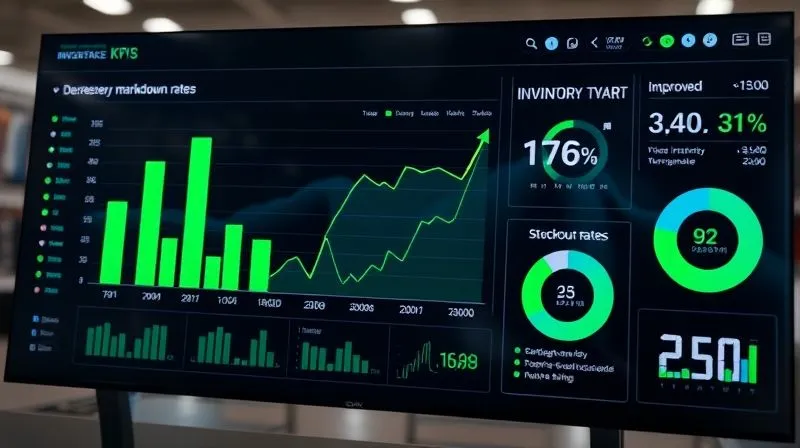
Measuring Success: KPIs for Overstock Reduction
To truly understand the impact of your predictive analytics initiatives, you must establish clear Key Performance Indicators (KPIs) and consistently measure them. As an expert, I always emphasize that what gets measured, gets managed.
- Inventory Turnover Ratio: This measures how many times inventory is sold and replenished over a period. A higher ratio generally indicates efficient inventory management.
- Days Inventory Outstanding (DIO): The average number of days it takes for inventory to be sold. Lower DIO means less capital tied up in stock.
- Markdown Rate: The percentage of sales revenue lost due to discounting. A significant reduction here is a direct indicator of success.
- Gross Margin Return on Investment (GMROI): This measures the profitability of your inventory. Predictive analytics should aim to increase this by optimizing stock levels.
- Stockout Rate: While focusing on overstock, it's vital to ensure you're not swinging too far the other way. A balanced approach maintains a healthy stockout rate for popular items.
- Waste Reduction Metrics: Quantify the reduction in discarded, donated, or recycled unsellable inventory. This highlights sustainability gains.
- Forecasting Accuracy: Directly measure the accuracy of your predictions against actual sales. Continuous improvement here is key to ongoing success.
Regularly review these KPIs, share them across relevant teams, and use them to refine your models and strategies. This iterative process of prediction, action, and measurement is the cornerstone of sustainable inventory optimization.
Frequently Asked Questions (FAQ)
Question: How long does it typically take to implement a robust predictive analytics system for fashion inventory? The timeline can vary significantly based on the size of your organization, the complexity of your data, and the existing tech infrastructure. For a mid-sized brand, a foundational system might take 6-12 months to implement and start showing tangible results. A full-scale, deeply integrated solution could take 18-24 months. It's an ongoing process of refinement, not a one-time project.
Question: What's the biggest challenge fashion companies face when adopting predictive analytics? In my experience, the biggest hurdle isn't the technology itself, but the cultural shift required. Moving from gut-instinct decisions to data-driven ones can be uncomfortable for seasoned professionals. Overcoming data silos, ensuring data quality, and securing leadership buy-in are also significant challenges that require dedicated effort and change management strategies.
Question: Is predictive analytics only beneficial for large fashion brands, or can smaller businesses leverage it too? While larger brands have more resources, the benefits of predictive analytics are accessible to businesses of all sizes. Many cloud-based SaaS solutions now offer scalable, affordable predictive analytics tools. Smaller brands can start with focused applications, such as predicting demand for their core product lines, and gradually expand. The key is to start smart, even if it's small.
Question: How accurate can predictive analytics get in predicting fashion trends and demand? No model can predict the future with 100% certainty, especially in the volatile fashion industry. However, well-built predictive models can achieve significantly higher accuracy than traditional methods, often reducing forecast errors by 20-50%. The goal isn't perfect prediction, but rather 'good enough' accuracy that enables better, more profitable decisions and significantly reduces overstock. Continuous retraining and feedback loops are crucial for maintaining and improving accuracy over time.
Question: How does predictive analytics address the specific challenges of 'fast fashion' with its incredibly short cycles? For fast fashion, predictive analytics is arguably even more critical. It allows brands to identify micro-trends as they emerge, optimize small-batch production, and manage rapid replenishment cycles. By analyzing real-time sales, social media buzz, and even competitor launches, fast fashion brands can make near-instantaneous decisions on what to produce, how much, and where to allocate it, minimizing the risk of being stuck with outdated stock within weeks. It's about maximizing agility through data.
Key Takeaways and Final Thoughts
The journey to stop fashion overstocking with predictive analytics is a transformative one, requiring commitment, strategic investment, and a willingness to embrace change. But the rewards – increased profitability, reduced waste, enhanced agility, and a more sustainable business model – are profound.
- Data is Your Gold: Invest in collecting and cleansing comprehensive internal and external data.
- Beyond Basic Forecasting: Embrace advanced machine learning for deeper insights and probabilistic outcomes.
- Actionable Intelligence: Ensure predictions seamlessly integrate into real-time inventory decisions.
- Optimize Every Stage: From initial buys to markdown strategies, use data for smarter choices.
- Build a Data Culture: Foster an environment where data informs every level of decision-making.
- Measure Relentlessly: Track KPIs to continuously refine your models and prove ROI.
In my years in this industry, I've seen that the brands that thrive are those that are not afraid to innovate. Predictive analytics is not just a technological tool; it's a strategic imperative for any fashion business looking to navigate the complexities of the modern market, minimize waste, and secure a profitable, sustainable future. Start your data-driven transformation today, and watch your inventory transform from a burden into your greatest asset.
Recommended Reading
- Best Comfort Shoes for Plantar Fasciitis Relief: Your Ultimate Guide
- Authenticating Vintage Chanel: 7 Expert Steps Without Original Papers
- 7 Proven Steps: Authenticate High-Value Vintage Dresses for Resale
- 7 Steps: Compelling Lookbooks on a Shoestring Budget & Small Team
- Runway Photography Redefined: Deliver High-Quality Images Quickly





Your email address will not be published. Required fields are marked *