

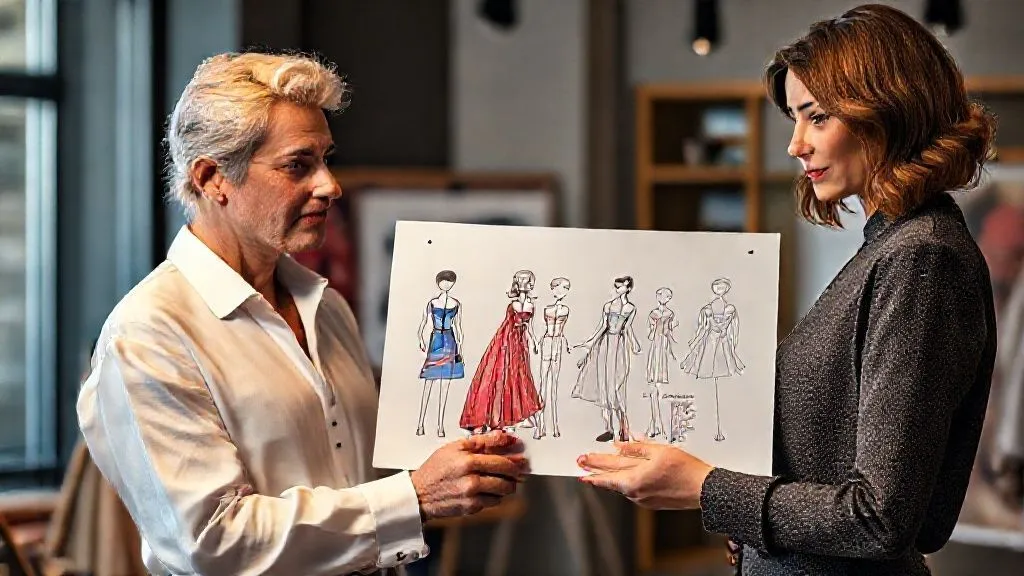
How to Secure Client Approval for Daring Conceptual Costume Designs?
For over two decades in the intricate world of costume design, I've witnessed firsthand the exhilarating highs of groundbreaking concepts brought to life and the crushing lows of brilliant visions left on the drawing board. I recall one particularly audacious design for a futuristic opera – a costume that defied gravity and conventional materials. My initial pitch was met with polite skepticism, a familiar glaze in the client's eyes that screamed, 'Too risky, too much.' It was a moment that underscored a fundamental truth: creativity alone isn't enough; securing buy-in for truly daring conceptual costume designs requires a strategic alchemy of vision, communication, and trust.
The problem isn't a lack of imagination; it's often a disconnect in translation. We, as designers, live in a world of fabric, form, and narrative possibility. Our clients, whether producers, directors, or marketing executives, operate within constraints of budget, practicality, and perceived audience acceptance. This chasm often leads to dilution, where your most innovative ideas are chipped away, not because they're bad, but because they haven't been effectively 'sold' or understood in their full potential. The pain of seeing a unique concept reduced to something 'safe' is a common lament in our industry.
This article isn't just about presenting your ideas; it's about building an unshakeable bridge between your conceptual brilliance and your client's practical realities. I will share with you a battle-tested framework, honed through countless pitches and projects, complete with actionable steps, a real-world case study, and expert insights. You’ll learn not just how to present, but how to persuade, how to anticipate, and ultimately, how to secure client approval for daring conceptual costume designs, transforming skepticism into shared excitement.
1. The Art of Pre-Visualization: Bridging the Imagination Gap
One of the most significant hurdles in securing approval for daring designs is that clients often struggle to visualize what doesn't yet exist. A simple sketch, no matter how beautiful, may not convey the texture, movement, or emotional impact of a truly conceptual piece. In my experience, the more avant-garde the design, the more critical it is to elevate your pre-visualization game beyond the ordinary.
Beyond the Sketch: High-Fidelity Mock-ups and Digital Renderings
Moving beyond basic sketches is not just an option; it’s a necessity for complex designs. Think of it as creating a 'visual argument' for your concept. This isn't about doing all the work upfront, but about providing just enough tangible reality to ignite your client's imagination and quell their practical anxieties. It demonstrates your commitment and professionalism, building an immediate layer of trust.
- 3D Digital Sculpting and Rendering: Utilize software like ZBrush, Marvelous Designer, or Clo3D to create hyper-realistic 3D models of your costumes. This allows clients to see the design from every angle, understand its construction, and even simulate fabric drape and movement.
- Photobashing and Digital Painting: Combine photographic elements with digital painting to place your costume concept onto a model or within a specific environment. This grounds the design in a realistic context, helping clients envision its final impact.
- Miniature Models and Maquettes: For architectural or highly structural costumes, a physical miniature model can be invaluable. It offers a tactile experience that digital renderings sometimes miss, allowing clients to physically interact with the form.
- Fabric Swatch Boards with Texture Mapping: Don't just show swatches; show how those textures will interact on the costume. Use digital tools to overlay fabric textures onto your 3D renders or physical boards to illustrate the material story.
- Movement Studies (Animated Storyboards): If movement is integral to your design (e.g., a cape that flows dramatically, an outfit that transforms), consider short animated storyboards or even simple video tests with similar materials. This is especially potent for performance-based projects.
By investing in these high-fidelity visualizations, you're not just showing a design; you're offering a glimpse into the finished product, minimizing the leap of faith the client needs to take. It's about making the intangible feel tangible.

2. Understanding Your Client's Language and Limitations
Before you even begin to sketch, truly understand the ecosystem your design will inhabit. This goes beyond the script or the brief; it delves into the client's risk tolerance, their budget philosophy, and their ultimate objectives. I've learned that a client's 'no' often stems not from a dislike of the design, but from a perceived misalignment with their underlying goals or an unaddressed fear.
Decoding Their Vision (and Blind Spots)
Every client, every project, comes with a unique set of parameters and unspoken expectations. Your role, as an expert, is to unearth these before they become roadblocks. This involves active listening, strategic questioning, and a deep dive into their previous successes and failures. What worked for them before? What were their biggest regrets? What are their non-negotiables?
For instance, a theatrical director might prioritize dramatic impact and character psychology, while a film producer might be more concerned with budget, practicality for stunts, and visual effects integration. A marketing client for a commercial might focus on brand alignment and audience recognition. Recognizing these nuances allows you to frame your daring design in terms that resonate directly with their priorities. As Harvard Business Review emphasizes, understanding and empathy are cornerstones of building trust and influence.
| Client Type | Primary Concern | Risk Tolerance (Creative) | Key to Approval |
|---|---|---|---|
| Film Producer | Budget, Practicality, VFX Integration | Moderate to Low (unless proven ROI) | Cost-benefit analysis, production feasibility, visual impact on audience |
| Theatrical Director | Character Arc, Stage Presence, Thematic Resonance | High (if serves narrative) | Dramatic impact, storytelling synergy, audience emotional connection |
| Brand/Marketing Executive | Brand Alignment, Audience Recognition, Media Impact | Moderate to High (if generates buzz) | Marketability, social media potential, brand messaging clarity |
| Private Individual (e.g., Gala) | Personal Vision, Uniqueness, Comfort | Varies wildly by individual | Emotional connection, bespoke craftsmanship, confidence-boosting aesthetics |
3. The Narrative Imperative: Weaving a Story Around Your Design
Daring conceptual designs rarely succeed on aesthetics alone. They need a compelling narrative, a 'why' that elevates them beyond mere decoration. This is where your expertise as a costume designer truly shines – you're not just making clothes; you're crafting visual storytelling tools. Every stitch, every silhouette, every chosen material should serve the overarching narrative of the project.
From Concept to Character Arc: Justifying the Daring
When presenting an unconventional design, don't just explain what it is; explain what it *does* for the story, the character, or the brand message. For instance, a costume with exaggerated proportions isn't just 'weird'; it's a visual metaphor for the character's inflated ego, their struggle with societal norms, or their transformation into something otherworldly. A fabric that seems impractical might be crucial for representing a character's connection to their environment or their unique abilities.
I once designed a costume for a sci-fi film where the protagonist's armor was made of seemingly fragile, iridescent scales. The client initially balked, fearing it looked too delicate for a warrior. My justification wasn't about aesthetics; it was about narrative. I explained that the scales were bio-luminescent, reacting to the character's emotional state – glowing brighter with fear, dimming with courage. This subtle visual cue allowed the audience to connect deeper with the character's internal journey, making the 'daring' choice integral to the storytelling. This is a core principle of effective design communication, as advocated by design luminaries like IDEO: focus on the 'why' and the user experience.
"A costume is not just what a character wears; it's what they *are*. It's their history, their aspirations, their camouflage, their declaration. Your daring design must speak this language." – Veteran Costume Designer's Axiom
Connect your design choices to:
- Character Psychology: How does the costume reveal their inner world, their journey, their hidden motives?
- World-Building: How does it establish the rules, aesthetics, and social structures of the narrative's universe?
- Thematic Resonance: Does it visually reinforce core themes like power, vulnerability, transformation, or rebellion?
- Audience Engagement: How will this design provoke curiosity, elicit emotion, or leave a lasting impression on the viewer?
4. Strategic Presentation: More Than Just Showing Pictures
The presentation itself is a performance, a carefully orchestrated experience designed to guide your client from skepticism to enthusiasm. It’s not just about showcasing your work; it’s about controlling the narrative, managing expectations, and building a shared vision. A poorly executed presentation can undermine the most brilliant design.
The Power of a Controlled Reveal
Don't dump all your daring ideas on the table at once. Build up to them. Start with established parameters, common ground, and designs that are less 'out there.' This establishes your credibility and demonstrates your understanding of the project's foundation. Then, introduce your more conceptual pieces as logical, albeit bold, evolutions.
- Set the Stage: Begin by reiterating the project's goals and how your overall design philosophy aligns. Reassure them that you've considered the practicalities.
- Show, Don't Just Tell: Use your high-fidelity visualizations (as discussed in Section 1) to do the heavy lifting. Let the visuals speak, then elaborate on their narrative significance.
- Highlight Key Innovations: Clearly articulate what makes the design daring and why that daring is essential for the project's success. Use strong, evocative language.
- Anticipate and Address Questions: Think like your client. What are their immediate concerns? Prepare concise, confident answers that connect back to narrative or practical solutions.
- Engage and Involve: Ask questions. "What are your initial thoughts on how this costume enhances [character's trait]?" This makes them part of the creative process, fostering ownership.
Case Study: How 'The Chrononaut's Cloak' Got Approved
I once worked on a historical fantasy series where the lead character, a time-traveling historian, needed a cloak that felt ancient yet subtly imbued with futuristic elements. My initial concept was a multi-layered, almost architectural garment that seemed to defy the period, featuring integrated light-emitting fibers and holographic embroidery. The director and producers were concerned it would pull audiences out of the historical setting.
My strategy: I first presented the historical accuracy of the base garment, showcasing its period-appropriate cut and materials. Then, I introduced the 'futuristic' elements as subtle, almost magical details, explaining that the light-emitting fibers were only visible under specific narrative conditions (e.g., when time-traveling), and the holographic embroidery was designed to mimic ancient patterns, only revealing its 'digital' nature upon closer inspection. I presented a 3D render showing the cloak in a historical setting, then a short animated sequence demonstrating the subtle activation of the futuristic elements. I emphasized that the daring elements were not for spectacle, but to visually manifest the character's unique temporal existence, making her feel both 'of her time' and 'beyond it'. By grounding the daring in narrative necessity and demonstrating its controlled visual impact, the client saw not a risk, but an innovative solution that deepened the story. The cloak became an iconic part of the series.
5. Anticipating Objections and Crafting Responses
The path to client approval for daring designs is rarely smooth. Expect objections. In fact, welcome them. They are not rejections of your creativity, but rather signals of specific concerns that, once addressed, can clear the way for your vision. The key is to anticipate these objections and prepare compelling, evidence-based responses.
Risk Mitigation Through Proactive Solutions
Clients are often risk-averse, and a daring design inherently carries perceived risks: budget overruns, impracticality, audience alienation, or simply not fitting the 'brand.' Your job is to pre-empt these fears. Think about the 'what if' scenarios and have a plan ready.
Common client objections and how to address them:
- "It's too expensive": Have a detailed breakdown of materials and construction costs. Offer tiered options (e.g., a fully realized version vs. a slightly simplified but still impactful alternative). Explain how the investment in this specific design will yield a greater return in terms of visual impact, marketing buzz, or character depth.
- "It's impractical/uncomfortable for the actor": Provide solutions. "We've incorporated hidden stretch panels here for movement," or "The weight will be distributed using a custom understructure." Demonstrate you've thought about the wearer.
- "The audience won't understand it/It's too alienating": Reiterate the narrative justification. "This design is intentionally provocative to highlight [theme/character trait] and stimulate discussion." Show how it aligns with the overall tone or genre. Cite examples of other successful 'daring' designs in similar projects.
- "It doesn't fit our brand/vision": This is where your deep understanding from Section 2 comes in. Reframe your design in their language. "While unconventional, this design pushes boundaries in a way that aligns with your brand's commitment to innovation and forward-thinking."
"An objection isn't a wall; it's a doorway. It's an invitation to provide more context, more solutions, and to deepen the client's understanding of your vision." – Industry Veteran Insight
I've found that having a 'Plan B' or a 'scaled-back' version of your daring design, which still retains its core essence, can be a powerful tool. It shows flexibility and a commitment to problem-solving, rather than rigid adherence to a single idea. This approach, rooted in proactive problem-solving, builds immense trust.
6. The Art of Compromise: Knowing When to Bend, Not Break
In the collaborative world of costume design, compromise is not a dirty word; it's a strategic tool. However, knowing *when* to compromise and *what* to compromise on is an art form itself. The goal is to retain the integrity of your daring concept while meeting the client's essential needs. It's about finding the 'sweet spot' where both artistic vision and practical requirements converge.
Defining Your Non-Negotiables
Before any negotiation, clearly define the core elements of your daring design that are absolutely non-negotiable – the elements without which the concept loses its essence. These might be a specific silhouette, a unique material interaction, or a critical symbolic detail. Everything else can be considered for adjustment.
Often, a client's request for change isn't about the *idea* but about a *specific manifestation* of that idea. They might say, "I don't like the color," when what they mean is, "This specific shade feels too aggressive for the character's journey." This is an opportunity to offer alternatives that still serve your daring vision but address their underlying concern. For example, if a client dislikes a very complex, structural element, could a simpler, more streamlined version achieve a similar visual impact with less cost or practical challenge? It's about creative problem-solving within new constraints.
Think of it as a strategic game of chess. You know your ultimate objective, but you're willing to sacrifice a pawn or move a knight differently to achieve checkmate. This flexibility, when applied thoughtfully, can actually strengthen your relationship with the client, demonstrating that you are a collaborative partner, not just a rigid artist. As Forbes points out, effective compromise is about finding mutually beneficial solutions.
7. Building Trust: The Foundation of Creative Freedom
Ultimately, securing client approval for daring conceptual costume designs hinges on one overarching factor: trust. When a client trusts your expertise, your judgment, and your commitment to their project's success, they are far more likely to take a leap of faith on an unconventional idea. This trust isn't built overnight; it's cultivated through consistent delivery, clear communication, and a genuine collaborative spirit.
Consistency, Communication, and Collaborative Spirit
Trust is an earned currency. Every successful project, every on-time delivery, every clear email, and every honest conversation deposits into that trust bank. When you consistently deliver high-quality work, meet deadlines, and communicate transparently about challenges and solutions, you establish yourself as a reliable and invaluable partner.
- Be a Proactive Communicator: Don't wait for problems to arise; provide regular updates. Share your progress, even small victories. This keeps the client informed and demonstrates your engagement.
- Demonstrate Expertise Beyond Design: Show that you understand the broader production context – budget constraints, technical requirements, logistical challenges. This positions you as a holistic problem-solver, not just an artist.
- Listen More Than You Speak: Truly hear your client's concerns, even if they seem minor. Validate their feelings before offering solutions. This builds empathy and rapport.
- Own Your Mistakes: If something goes wrong, acknowledge it, take responsibility, and present a solution. This builds far more trust than trying to hide or deflect.
- Educate, Don't Dictate: When proposing a daring concept, frame it as an educational journey. Explain the 'why' and the 'how' in an accessible, engaging manner, rather than simply stating your preference.
When a client truly trusts you, they're not just approving a design; they're investing in *your vision* and *your ability* to bring it to life successfully. This allows for far greater creative freedom and opens the door for truly groundbreaking work. The Costume Society of America frequently highlights the importance of professional relationships in advancing the art of costume design.
Frequently Asked Questions (FAQ)
Q: How do I handle a client who says "I don't know what I want, but not that"? This is a classic! It means they're reacting to a perceived 'wrong' without understanding the 'right' for them. Instead of defending your design, pivot to active listening and discovery. Ask open-ended questions like, "What specifically about this isn't resonating?" or "Can you describe what feeling or impression you *are* hoping for?" Sometimes, showing them two or three very different iterations, including one that's intentionally 'safe,' can help them articulate their preferences by contrast. Your goal is to help them find their language, not just impose yours.
Q: What if my budget doesn't allow for high-fidelity mock-ups or 3D renders? Resourcefulness is key. While high-end tools are fantastic, they aren't always essential. Focus on the most impactful visual aids you *can* create. This might mean meticulously crafted mood boards with fabric swatches and found imagery, detailed concept art with strong rendering skills, or even simply bringing in a physical garment with similar construction or material to demonstrate a principle. The goal is clarity and emotional resonance, regardless of the tool. Sometimes, a beautifully rendered traditional painting can be more persuasive than a clunky 3D model.
Q: How much research is too much before a pitch? There's no 'too much' when it comes to understanding your client and their project. However, there's a point of diminishing returns for *presenting* all that research. Your research should inform your design and your strategy, not overwhelm the client. Present only the most relevant insights that directly support your design choices or address potential concerns. The depth of your knowledge should be felt, not necessarily explicitly stated in every detail. Focus on translating complex research into simple, compelling justifications for your daring designs.
Q: Is it ever okay to push back aggressively on a client's request for change? 'Aggressive' is rarely the right approach. 'Assertive' and 'expert-led' are better. There are times when a client's requested change will fundamentally undermine the project's success or your artistic integrity. In such cases, you must advocate for your vision. Frame your pushback not as defiance, but as a professional recommendation based on your expertise. Explain the negative consequences of their proposed change using narrative, practical, or audience-impact justifications. Offer alternative solutions that address their underlying concern without sacrificing your core concept. Sometimes, a firm, well-reasoned 'no' backed by strong evidence is the most professional response.
Q: How do I protect my original ideas during the approval process, especially for very conceptual designs? This is a critical concern for any creative. Always have a clear contract outlining ownership of intellectual property and design usage. Before sharing highly detailed or unique concepts, especially with new clients, consider using non-disclosure agreements (NDAs). Document every stage of your design process – sketches, mood boards, renders – with dates. Clearly brand your presentations and visuals. While legal protection is important, the best defense is often a strong, trusting relationship and a reputation for professionalism. If a client respects you, they are less likely to exploit your ideas.
Key Takeaways and Final Thoughts
Securing client approval for daring conceptual costume designs is a nuanced skill, blending artistic vision with strategic communication and deep empathy. It's a journey from inspiration to integration, demanding not just creativity, but also astute business acumen and interpersonal intelligence. Remember these core principles:
- Visualize, Don't Just Describe: Use high-fidelity tools to bridge the client's imagination gap.
- Understand Their World: Decode client motivations, limitations, and fears before you present.
- Narrate Your Vision: Connect every daring design choice to the overarching story or purpose.
- Strategize Your Presentation: Control the reveal, anticipate objections, and engage collaboratively.
- Prepare for Pushback: Have proactive, evidence-based responses ready for common concerns.
- Master the Art of Compromise: Know your non-negotiables and offer flexible solutions that maintain core integrity.
- Build Unshakeable Trust: Consistency, clear communication, and a collaborative spirit are your greatest assets.
Your daring designs are not just costumes; they are powerful statements, critical narrative elements, and extensions of your unique artistic voice. Don't let them be diluted by a lack of strategic presentation. Embrace these techniques, refine your approach, and watch as your most audacious visions not only gain approval but transform into iconic realities that captivate audiences and elevate the art of costume design. Go forth, design boldly, and persuade brilliantly.
Recommended Reading
- Desert Ultras: 7 Apparel Strategies for Peak Running Performance
- Squat-Proof Seamless: 7 Engineering Secrets to Eliminate Activewear Transparency
- Unlock Sustainable Style: How to Buy Fashion Without Greenwashing Lies
- Cracking the Code: How to Ensure Toddler Outfits Meet Strict Safety Standards
- Elevate Your Interview Look: 7 Steps to Master Smart Casual for a Promotion


Your email address will not be published. Required fields are marked *