


What to do when a new sandal design faces manufacturing limits?
For over two decades in the footwear industry, I've witnessed countless aspiring designers and established brands alike hit a wall – the exhilarating moment of a groundbreaking sandal design meets the sobering reality of production limitations. It's a common, often devastating, setback. I've seen promising collections shelved indefinitely, market opportunities lost, and significant investments wasted, all because the vision outpaced the manufacturing capability.
The problem isn't usually a lack of creativity or market understanding; it's a disconnect between design aspiration and manufacturing practicality. You've poured your heart and soul into a unique sandal, perhaps with intricate detailing, novel materials, or a complex construction, only to find your chosen factory can't scale it, maintain quality, or produce it within a viable budget or timeframe. This isn't just a logistical headache; it's a blow to your passion and your business's potential, leaving you questioning what steps to take next.
But here's the good news: this challenge, while formidable, is far from insurmountable. In this definitive guide, I will share the frameworks, hard-earned lessons, and actionable strategies I've developed and refined over my career. You'll learn not just what to do when a new sandal design faces manufacturing limits, but how to proactively build resilience, optimize your processes, and forge partnerships that transform these obstacles into stepping stones for scalable success. We'll delve into everything from design considerations to supply chain mastery, ensuring your innovative sandals don't just stay on paper, but walk confidently into the market.
Understanding the Root Causes of Manufacturing Limits
Before we can solve a problem, we must first understand its genesis. Manufacturing limits for a new sandal design rarely stem from a single issue; they're often a confluence of factors, each contributing to the bottleneck. In my experience, identifying these root causes early is paramount.
Material Scarcity or Exclusivity
Many innovative sandal designs rely on unique or exotic materials – a specific type of vegan leather, a sustainably sourced natural fiber, or a specially treated rubber. While these materials might set your design apart, they can also be your biggest hurdle. Limited suppliers, long lead times, minimum order quantities (MOQs) that are too high for initial runs, or even geopolitical factors affecting raw material availability can quickly halt production.
Skilled Labor and Specialized Equipment
The craftsmanship involved in high-quality sandal production is often underestimated. Intricate stitching, complex assembly techniques, or the need for specific finishing processes demand highly skilled artisans and specialized machinery. If your design requires a technique that isn't common, or equipment that your current manufacturer doesn't possess, scaling becomes a significant issue. Training new labor or acquiring new machinery is costly and time-consuming, creating a natural limit.
Design Complexity and Assembly Time
A beautifully complex design might be a feast for the eyes, but it can be a nightmare for the production line. More components mean more steps, more potential points of failure, and longer assembly times. This directly impacts labor costs and overall output. I've seen designs that looked fantastic on paper but required such precise, fiddly work that they effectively doubled the production time per unit, making them economically unviable at scale.
Geographical and Logistical Constraints
Where your sandals are made and where your materials come from can also impose limits. Shipping costs, customs delays, political instability, and even natural disasters can disrupt supply chains. The closer your material suppliers are to your manufacturing facility, and the closer your manufacturing facility is to your distribution centers, the smoother your operation tends to be.
"Understanding your supply chain's vulnerabilities is the first step toward building resilience. Don't wait for a crisis to expose your weaknesses; proactively audit every link." - Industry Veteran Insight
To truly grasp these issues, a detailed audit of your design's requirements against your current or prospective manufacturer's capabilities is essential. This isn't about compromise; it's about informed decision-making.
The Power of Design for Manufacturability (DFM) in Footwear
This is where the magic happens, or where it fails to. Design for Manufacturability (DFM) is not just an engineering concept; it's a philosophy that should permeate every stage of sandal design and development. It's about designing your product not just for aesthetics and function, but also for ease, efficiency, and cost-effectiveness of production. I often tell designers, "A great design isn't just beautiful; it's buildable."
Integrating DFM from Concept to Prototype
The biggest mistake I've observed is bringing DFM into the conversation too late. It needs to be part of your initial design brief. Collaborate closely with your manufacturing partners, or at least a manufacturing expert, from the very first sketch. They can offer invaluable insights into material alternatives, construction methods, and process optimizations that might not be apparent to a pure designer.
- Early Manufacturer Engagement: Share concepts and early sketches with your production team. Their input on material availability, specific machinery requirements, and assembly complexity can guide your design choices before costly prototypes are made.
- Material Rationalization: Explore readily available, high-quality alternatives to rare or expensive materials. Can a synthetic leather mimic the look and feel of an exotic skin without the supply chain headaches? Can a recycled rubber offer the same durability as virgin rubber?
- Component Standardization: Where possible, use standard components like buckles, eyelets, or sole units that are widely available and don't require custom tooling. This reduces lead times and costs, and makes sourcing much easier.
- Assembly Simplification: Look for ways to reduce the number of components or simplify the assembly process. Can two parts be molded as one? Can a complex stitching pattern be replaced with a cleaner, equally attractive, heat-sealed or bonded alternative?
- Prototyping Iterations with DFM in Mind: Don't just prototype for aesthetics. Create prototypes specifically to test manufacturability, identifying and resolving production challenges before moving to mass production.
Case Study: Streamlining 'AquaStride' Sandals
Case Study: How 'AquaStride' Simplified Production
A few years ago, a new brand, 'AquaStride,' developed an innovative sandal for watersports, featuring a complex multi-layer sole and a unique quick-drying strap system. Initial prototypes were stunning, but manufacturing quotes came back prohibitively high, citing extensive hand-stitching and a custom-molded sole that required highly specialized equipment. Their initial production run was capped at a fraction of their market demand.
By implementing a rigorous DFM review, we identified several key areas for improvement. First, the multi-layer sole was redesigned to be a single injection-molded unit with integrated texture, reducing assembly steps and material waste. Second, the complex strap stitching was replaced with a combination of high-frequency welding and strategic reinforcement points, maintaining durability without the intensive labor. This resulted in a 40% reduction in per-unit labor time and a 25% decrease in material costs, allowing AquaStride to meet their demand forecasts and launch successfully within budget.
Rethinking Your Supply Chain: Diversification and Strategic Partnerships
A robust and resilient supply chain is the backbone of any successful footwear brand, especially when facing manufacturing limits. Relying on a single supplier or a single region is a risk I strongly advise against. Diversification and strategic partnerships are not just buzzwords; they are essential survival strategies.
Diversifying Your Supplier Base
This means having multiple sources for your key materials and components, ideally in different geographical regions. If one supplier faces a natural disaster, political unrest, or simply can't meet your demand, you have alternatives. This takes time and effort to build, but the security it provides is invaluable.
- Identify Critical Components: Determine which materials or components are essential and most susceptible to supply chain disruption.
- Research and Vet Alternatives: Actively seek out and qualify new suppliers, even if you don't use them immediately. Build relationships.
- Dual Sourcing: For high-risk items, aim to have at least two approved suppliers from the outset.
Vertical Integration and Strategic Alliances
Consider the benefits of vertical integration, where you own or control more steps in your supply chain. This could mean investing in your own tooling, having an exclusive partnership with a material producer, or even acquiring a small manufacturing unit for critical processes. While capital-intensive, it offers unparalleled control and can mitigate significant risks.
Strategic alliances with manufacturers go beyond a simple client-supplier relationship. It involves sharing forecasts, co-investing in new technologies, and working together on R&D. These deep partnerships foster loyalty and ensure that your brand is prioritized, especially during times of high demand or unforeseen challenges. As Harvard Business Review often highlights, strong supplier relationships are critical for supply chain resilience.

Optimizing Production Processes: Lean Manufacturing & Technology
Once your design is manufacturable and your supply chain is robust, the next frontier is optimizing the actual production process. This is where lean manufacturing principles and the smart application of technology can dramatically increase output and efficiency, directly addressing what to do when a new sandal design faces manufacturing limits.
Embracing Lean Manufacturing Principles
Lean manufacturing, at its core, is about eliminating waste in all its forms: overproduction, waiting, unnecessary transport, over-processing, excess inventory, unnecessary motion, and defects. Applying these principles to sandal production can yield significant gains.
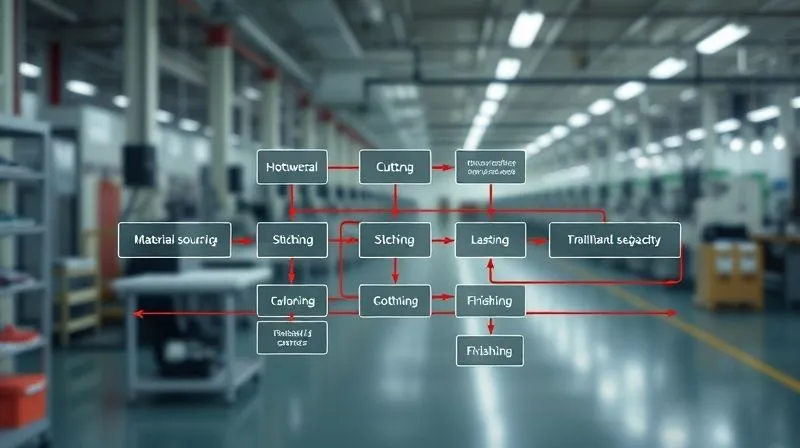
- Value Stream Mapping: Map out every step of your production process from raw material to finished product. Identify non-value-adding activities and bottlenecks.
- Just-In-Time (JIT) Inventory: Reduce inventory holding costs and waste by receiving materials only when they are needed for production. This requires excellent forecasting and strong supplier relationships.
- Continuous Improvement (Kaizen): Foster a culture where every employee is encouraged to identify and suggest improvements to processes. Small, incremental changes can lead to monumental gains over time.
- Standardized Work: Document the most efficient way to perform each task. This ensures consistency, reduces errors, and simplifies training.
Leveraging Technology for Efficiency
Modern technology offers powerful tools for optimizing footwear production:
- CAD/CAM Systems: Computer-Aided Design and Manufacturing can streamline pattern making, cutting, and component design, reducing material waste and improving precision.
- Automated Cutting Machines: Robotic cutters can precisely cut multiple layers of material, significantly faster and with less waste than manual methods.
- 3D Printing for Prototyping and Tooling: Accelerate your prototyping cycles and even create custom tooling faster and more cost-effectively with additive manufacturing.
- Enterprise Resource Planning (ERP) Systems: Integrate all aspects of your business – from inventory and purchasing to production and sales – for real-time visibility and better decision-making.
As Forbes often emphasizes, adopting lean practices and smart technology isn't just about cutting costs; it's about building agility and responsiveness into your operations.

Navigating Capacity Constraints: Phased Rollouts & Demand Management
Even with DFM and optimized production, you might still face hard capacity limits. This doesn't mean your design is doomed; it means you need a strategic approach to market entry and demand management. This is about being smart with your launch strategy when you know your initial production volume is restricted.
Phased Rollouts and Limited Editions
Instead of trying to flood the market with a product you can't consistently supply, consider a phased rollout. This allows you to test the waters, gather feedback, and gradually scale production as capacity increases.
- Geographical Phasing: Launch in a specific region or country first, then expand.
- Channel Phasing: Start with direct-to-consumer (DTC) sales before expanding to wholesale partners.
- Limited Edition Drops: Create exclusivity and hype around a limited initial run. This can generate significant buzz and pre-orders for future, larger batches.
Pre-Order Campaigns and Demand Forecasting
Pre-orders are an excellent way to gauge actual market demand and secure funding for larger production runs, all while managing customer expectations. However, transparency is key – be clear about delivery timelines.
Accurate demand forecasting is crucial. Utilize historical sales data (if available for similar products), market research, trend analysis, and even AI-powered predictive analytics. Overestimating demand can lead to excess inventory, while underestimating can mean missed sales and frustrated customers. As marketing guru Seth Godin often says, "The market doesn't pay for what you make, it pays for what you sell." Knowing what you can sell, and how much, is paramount.
| Strategy | Benefit | Challenge |
|---|---|---|
| Phased Rollout | Reduced initial risk, market testing | Slower market penetration |
| Limited Edition | Hype generation, exclusivity | Potential for unmet demand |
| Pre-Order Campaign | Demand validation, upfront capital | Customer patience, fulfillment logistics |
| Demand Forecasting | Optimized inventory, resource allocation | Data accuracy, market volatility |
Quality Control and Ethical Sourcing: Non-Negotiables in Scaling
As you scale production to overcome manufacturing limits, there's a temptation to cut corners to meet demand. I cannot stress this enough: do NOT compromise on quality or ethical sourcing. These are not just cost centers; they are brand protectors and reputation builders.
Robust Quality Control Protocols
Implementing stringent quality control (QC) at every stage of production is vital. This goes beyond a final inspection. It includes:
- Incoming Material Inspection: Verify the quality of all raw materials before they enter production.
- In-Process Checks: Monitor quality at critical stages of manufacturing, such as cutting, stitching, and assembly.
- Final Product Inspection: A thorough check of every finished sandal against your specifications before packaging.
- Defect Analysis and Corrective Actions: Don't just identify defects; analyze their root causes and implement corrective actions to prevent recurrence.
"Quality is not an act, it is a habit. Especially when scaling, consistency in quality builds customer loyalty faster than any marketing campaign." - My personal mantra.
Commitment to Ethical and Sustainable Sourcing
Consumers today are more aware and demanding when it comes to the ethical and environmental impact of their purchases. Scaling production responsibly means ensuring your supply chain adheres to high standards of labor practices, environmental stewardship, and transparency. This includes:
- Supplier Audits: Regularly audit your manufacturing partners and material suppliers for fair labor practices, safe working conditions, and environmental compliance.
- Traceability: Strive for full traceability of your materials, from raw source to finished product.
- Sustainable Materials: Continue to explore and integrate sustainable materials and processes into your designs and production.
Compromising on these aspects can lead to devastating reputational damage and legal repercussions. Investing in quality and ethical practices is an investment in your brand's long-term viability and customer trust. Learn more about ethical sourcing in footwear here.
Financial Projections and Risk Mitigation for New Designs
Launching a new sandal design, especially one facing manufacturing limits, requires astute financial planning and a robust risk mitigation strategy. It's not just about making the sandals; it's about making a profit and ensuring business continuity. This is a critical piece of the puzzle for what to do when a new sandal design faces manufacturing limits.
Detailed Cost Analysis and Pricing Strategy
You need a granular understanding of all costs associated with your new design. This goes beyond material and labor. Consider:
- Unit Cost Breakdown: Material costs, direct labor, manufacturing overhead (rent, utilities, maintenance), packaging.
- Logistics Costs: Shipping raw materials, finished goods, customs duties, warehousing.
- Marketing & Sales Costs: Advertising, photography, website, sales commissions.
- Operating Expenses: Design, R&D, administrative salaries, insurance.
Once you have a clear picture of your total costs, you can determine a viable pricing strategy that covers expenses, generates profit, and remains competitive in the market. Don't be afraid to adjust your design or production strategy if the numbers don't add up.
Scenario Planning and Contingency Funds
What if material costs increase unexpectedly? What if a key machine breaks down? What if demand is lower than anticipated? Scenario planning involves identifying potential risks and developing strategies to address them. This includes:
- Best-Case, Worst-Case, and Most Likely Scenarios: Project financials under different market and operational conditions.
- Contingency Budget: Allocate a percentage of your overall budget (I recommend 10-15% for new designs) to cover unforeseen expenses or delays.
- Alternative Funding: Explore options like lines of credit or investor relationships that can be leveraged if cash flow becomes tight.
As financial experts at Deloitte often advise, proactive risk management is not an optional extra; it's a fundamental component of sustainable growth, especially for innovative products.
Frequently Asked Questions (FAQ)
Question? When should I start thinking about Design for Manufacturability (DFM) for a new sandal design?
Answer: You should integrate DFM from the very initial concept phase, not as an afterthought. As soon as you have sketches or rough ideas, engage with manufacturing experts or your production team. Their early input on material choices, construction methods, and available tooling can prevent costly redesigns and delays down the line. It's far easier and cheaper to make changes on paper than on a physical prototype or, worse, after tooling has been created.
Question? How do I find reliable overseas manufacturers if my current one can't meet demand or complexity?
Answer: Finding reliable overseas manufacturers requires due diligence. Start by networking within the industry, attending trade shows (like MICAM in Milan or FN Platform in Las Vegas), and leveraging online B2B platforms like Alibaba or Thomasnet, though these require careful vetting. Always request samples, visit factories if possible, check references, and ideally, work with a trusted sourcing agent. Prioritize factories with transparent communication, a strong track record, and certifications for quality and ethical practices. Don't just look for the lowest price; look for a partner.
Question? Is automation always the answer to overcoming manufacturing limits in footwear?
Answer: Not always, but it's a powerful tool. Automation can significantly increase efficiency, precision, and consistency for repetitive tasks like cutting, stitching, or sole attachment. However, it's a significant investment and may not be suitable for highly intricate, artisanal processes that rely on human touch. The key is to identify specific bottlenecks that automation can effectively address without sacrificing the unique qualities of your sandal design. A hybrid approach, combining automated processes with skilled manual craftsmanship, often yields the best results.
Question? What if my sandal design is inherently complex and cannot be significantly simplified without losing its unique appeal?
Answer: If your design's complexity is integral to its appeal, then your strategy shifts from simplification to specialized production and premium positioning. This means finding manufacturers who specialize in high-craft, low-volume production. Your marketing and pricing must reflect this exclusivity and the artisanal value. Consider limited edition runs, made-to-order models, or a higher price point that justifies the increased production cost. In this scenario, managing customer expectations about availability and lead times becomes even more crucial.
Question? How do I balance maintaining high quality with the pressure to scale production quickly?
Answer: Balancing quality and speed is a perpetual challenge. The solution lies in robust quality control (QC) protocols embedded throughout the production process, not just at the end. Implement strict material inspection, in-process checks at every critical stage, and continuous training for your production team. Invest in technology that enhances precision and reduces human error. Furthermore, a phased rollout strategy can allow you to scale gradually, giving your manufacturing partners time to refine processes and maintain quality standards without being overwhelmed by immediate, massive demand. Never sacrifice quality for speed; it invariably backfires.
Key Takeaways and Final Thoughts
Navigating the complexities of manufacturing limits for a new sandal design is a journey that demands foresight, flexibility, and an unwavering commitment to both innovation and practicality. It's a true test of a brand's resilience and strategic acumen. I've seen brands emerge stronger from these challenges, and others falter. The difference often lies in their approach.
- Proactive DFM: Integrate Design for Manufacturability from the earliest stages of design to minimize future production hurdles.
- Diversified Supply Chain: Build a resilient network of suppliers to mitigate risks and ensure material availability.
- Optimized Processes: Embrace lean manufacturing and smart technology to enhance efficiency and capacity.
- Strategic Market Entry: Use phased rollouts and demand management to align production with market opportunity.
- Uncompromising Standards: Maintain rigorous quality control and ethical sourcing practices, even under pressure to scale.
- Financial Acumen: Understand your costs, plan for contingencies, and price strategically to ensure profitability.
Remember, a manufacturing limit isn't a dead end; it's an invitation to innovate your processes, refine your partnerships, and solidify your strategic vision. By adopting these expert-driven strategies, you're not just overcoming a problem; you're building a more robust, sustainable, and successful future for your footwear brand. Your next groundbreaking sandal design deserves to see the light of day, and with these insights, you're well-equipped to make that happen.
Recommended Reading
- 7 Ways to Halt Antimicrobial Fabric Degradation Post-Wash Cycles
- 7 Pillars: How to Maintain Luxury Footwear Exclusivity Online
- Runway to Reader: 7 Actionable Ways to Master Engaging Fashion Blog Posts
- Unlock the Secret: How to Prevent Platinum Jewelry from Scratching Easily
- The Future of Fashion: How Advanced Materials Will Reshape Clothing Design



Your email address will not be published. Required fields are marked *