

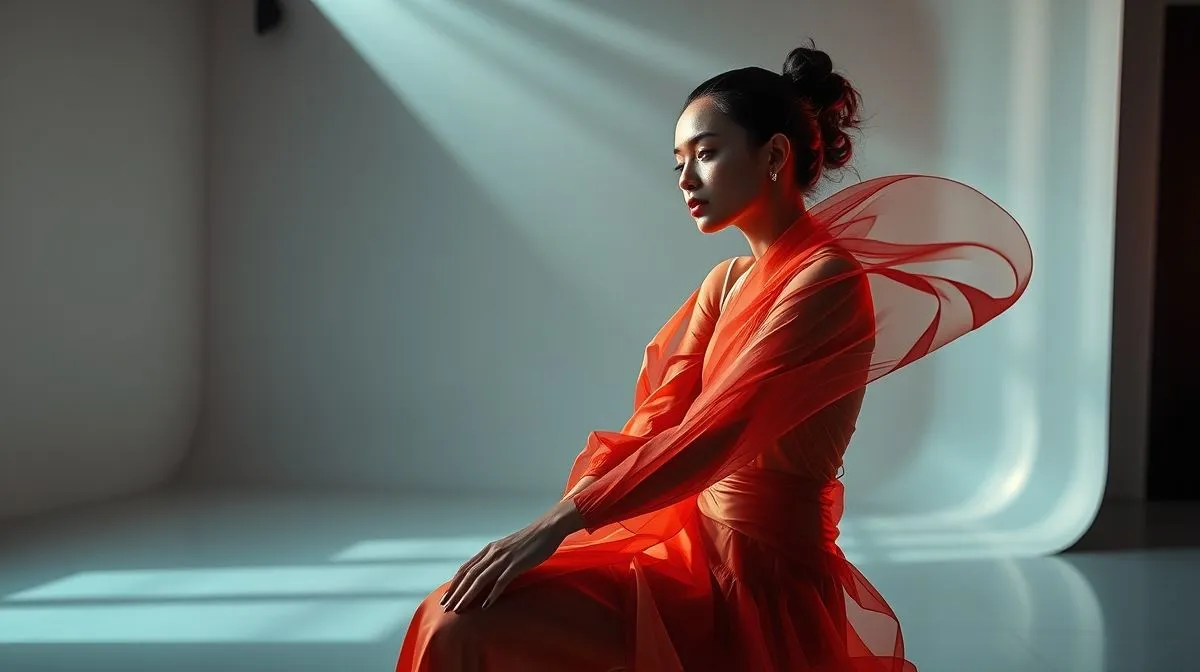
How to direct inexperienced fashion models for natural, dynamic poses?
Directing inexperienced models for natural, dynamic poses is less about dictating specific angles and more about cultivating an environment where genuine expression can flourish. In my fifteen years behind the lens, I've learned that the most compelling images emerge when a model feels comfortable, understood, and empowered. The first, and arguably most crucial, step is to **build immediate rapport**. Before the camera even comes out, engage them in conversation. Ask about their interests, their comfort levels, and what they hope to gain from the shoot. This human connection is the bedrock of trust.A common mistake I see emerging photographers make is jumping straight into complex posing instructions. Instead, think of yourself as a **movement coach**, not a statue sculptor. Your goal is to elicit motion and emotion, not rigid stillness.
"The most powerful photographs aren't posed; they are captured moments of authentic human experience, guided into being by a thoughtful director."To achieve this, I often employ a technique I call "Action-Oriented Cues." Rather than saying "put your hand here," I'll prompt them with a scenario or an action verb. This encourages them to *feel* the pose, not just mimic it. Here are some practical applications of Action-Oriented Cues:
- Instead of "Arch your back," try: "Imagine you're stretching languidly after a long sleep."
- Instead of "Look at the camera," try: "Gaze towards the light as if you've just spotted something intriguing in the distance."
- Instead of "Cross your arms," try: "Hug yourself gently, feeling the texture of the fabric."
This approach taps into their imagination, which is far more effective than rote instruction. It's like directing an actor; you give them a motivation, and their body language naturally follows. I often use **mini-narratives** to set the scene, providing a context for their movements and expressions.
For instance, if we're shooting a coat, I might say, "You've just stepped out into a crisp autumn morning, and the air is invigorating. Feel the warmth of the coat as you pull it around you." This narrative immediately translates into more authentic gestures and a natural, relaxed demeanor.Another powerful tool is **demonstration, but with a caveat**. While it can be helpful to show a general idea of a pose, avoid mirror-imaging them exactly. This can make them feel self-conscious or like they're failing to replicate your perfection. Instead, demonstrate a *feeling* or a *direction* of movement.
I often use my own body to show the *energy* of a pose – a lean, a stretch, a subtle shift of weight – and then encourage them to interpret it in their own way. "Give me your version of that stretch," I'll say, fostering their individuality.Utilizing **props and the environment** is also key. Inexperienced models often feel awkward because they don't know what to do with their hands or where to look. Giving them something to interact with provides a natural anchor for their gaze and limbs.
Consider these interactions:- "Run your fingers through the fabric of the dress."
- "Lean casually against that wall, as if you're waiting for a friend."
- "Play with the brim of the hat, lost in thought."
Finally, **constant, specific positive reinforcement** is non-negotiable. When you see something you like, vocalize it immediately and explain *why* it works. "That subtle tilt of your head, right there – it adds such intriguing mystery!" This not only boosts their confidence but also teaches them what to repeat.
In my experience, patience is your greatest virtue. Allow for moments of quiet, give them space to breathe, and be ready to capture the unexpected, candid moments that often occur between explicit directions. These unposed instances are frequently where the magic truly happens.
Understanding the Root of the Problem: Why Does Getting Natural, Dynamic Poses from Inexperienced Models Happen?
In my fifteen years behind the lens, few challenges are as universally frustrating for photographers as coaxing genuinely natural, dynamic poses from an inexperienced model. It's not merely a lack of technical skill on their part; rather, it's a complex interplay of psychological barriers and environmental pressures that often stifle organic movement. At the heart of the issue lies what I call the 'camera-induced paralysis'. For someone new, the lens can feel like an all-seeing eye, amplifying self-consciousness to an almost debilitating degree. They become acutely aware of every limb, every facial expression, leading to stiffness. This isn't unlike a public speaker who freezes when they first step onto a stage; the pressure to perform perfectly overrides natural instinct. Another significant factor is a fundamental lack of body awareness when translated to a two-dimensional medium. What feels natural in real life often looks awkward or exaggerated on camera. Inexperienced models haven't yet developed the proprioceptive understanding of how their movements and posture will register in a photograph. This leads to overthinking, where they try to "pose" rather than simply "be." Every movement becomes a conscious, effortful decision, stripping away spontaneity and fluidity. And let's be honest, we, as photographers, often contribute to the problem. Vague or overly technical instructions like "give me more energy" or "arch your back more" can be incredibly unhelpful, even counterproductive, for someone who lacks a visual vocabulary of posing. They might interpret "dynamic" as "exaggerated" or "natural" as "static," leading to a disconnect between our vision and their execution. Beyond the internal struggles, the environment itself can be a major inhibitor. A cold studio, a rushed schedule, or a crew that isn't openly supportive can instantly create an atmosphere of unease. In my experience, a model who doesn't feel safe, seen, and genuinely connected to the photographer will rarely, if ever, truly let go and deliver authentic expression."A camera doesn't just capture light; it captures energy. If the model's energy is consumed by anxiety or confusion, the resulting image will reflect that internal struggle, not the grace you seek."Understanding these underlying issues is the crucial first step. It shifts our approach from simply demanding better poses to proactively creating an environment and providing guidance that nurtures genuine expression.
How do I make models feel comfortable on set?
In my 15+ years behind the lens, I've learned that the single most critical factor in eliciting natural, dynamic poses from any model, especially an inexperienced one, is their comfort level. A truly relaxed model isn't just a happier model; they're an uninhibited conduit for genuine emotion and authentic movement, which is precisely what we aim to capture.
Comfort begins long before the flash fires. A common mistake I see is a lack of comprehensive pre-shoot communication. Before the day, provide a detailed brief including the shoot's mood board, wardrobe requirements, and a clear schedule, even if approximate. This proactive transparency helps to demystify the process and significantly reduce pre-shoot anxiety.
Think of it like hosting a dinner party; you wouldn't invite guests without telling them the time or what to expect, would you? Similarly, for a model, knowing what's coming allows them to mentally prepare, reducing the unknown variables that often fuel nervousness.
Upon arrival, a warm, genuine welcome is paramount. Introduce them to every key team member – stylist, makeup artist, assistant – by name and role. This simple act acknowledges their presence as a valued collaborator, not just a subject.
The physical environment itself plays a huge role. Ensure there's a private, clean changing area, easily accessible refreshments (water, snacks), and a comfortable temperature. I always ask about music preferences; a carefully curated playlist can instantly relax the atmosphere and help the model feel more at ease, allowing them to settle into their own rhythm.
Acknowledge their potential nervousness directly but gently. A simple, "It's completely normal to feel a little nervous on your first few shoots, just let me know if you need anything at all," can be incredibly validating. This opens a channel for honest communication and builds trust.
Offer small choices where appropriate. For instance, "We have a few options for this look; which one feels most comfortable to you?" or "Would you prefer to start with a seated pose or something standing?" These micro-decisions give them a sense of control in an otherwise directed environment.
Throughout the shoot, be generous and specific with your praise. Instead of a vague "Good job," try, "That slight tilt of your head perfectly caught the light and conveyed the emotion we're looking for." This not only builds confidence but also helps them understand what's working, enabling them to replicate or adapt.
Regular, brief breaks are non-negotiable. Fatigue quickly erodes comfort and authenticity. During these breaks, check in with them. "How are you feeling? Do you need anything?" This demonstrates you see them as a person, not just a prop, and provides an opportunity for them to voice any concerns privately.
Periodically, show them a few images on the camera's display. This isn't just about validation; it helps them understand how their movements translate to the final image. It's a collaborative process, and seeing successful results can be a huge confidence booster, inspiring further natural expression.
"True comfort on set isn't just the absence of discomfort; it's the presence of trust, respect, and a shared understanding that empowers the model to truly shine."
Ultimately, your own demeanor sets the tone. Remain calm, confident, and organized, even when challenges arise. A photographer who projects professionalism and control instills confidence in their team and, crucially, in the model. This calm leadership fosters an environment where creativity can flourish free from unnecessary stress.
What are common mistakes to avoid when directing new models?
In my fifteen years behind the lens, I've seen countless emerging photographers make the same fundamental errors when working with new talent. These missteps often stem from a blend of inexperience and a genuine desire to achieve the perfect shot, yet they inadvertently stifle the very naturalism we seek.
A primary pitfall I consistently observe is **over-directing and micromanaging**. It's easy to fall into the trap of dictating every finger placement or subtle head tilt. However, this approach quickly drains a new model's energy and confidence, turning them into a marionette rather than a creative collaborator.
They become so focused on executing precise instructions that they lose all organic flow and genuine expression. Instead of building a pose from the ground up, consider giving them a framework. For instance, rather than saying, "Move your left arm 3 inches to the right," I'd say, "Imagine you're reaching for something just out of frame, a little hesitant, a little curious." This empowers them to interpret and embody the feeling, leading to more authentic movement. Think of yourself as a conductor, not a puppeteer.
Another significant error is using **vague or abstract language**. Phrases like "just be natural," "give me more emotion," or "make it fashion" are utterly unhelpful to someone still finding their footing. They lack actionable guidance and leave the model feeling bewildered and inadequate, unsure of what 'natural' or 'fashion' even means in that specific context.
When I work with new models, I always break down the 'why' behind the shot. If I want a powerful gaze, I won't just say 'look powerful.' I'll say, "Imagine you're seeing your biggest dream come true, right there, just beyond the lens. How does that make your eyes feel?" This provides a clear, emotional anchor for their expression, yielding far more impactful results than generic commands.
Furthermore, many photographers neglect the crucial step of **building rapport and ensuring comfort**. A new model, especially, is highly sensitive to the atmosphere on set. Rushing into demanding poses without a warm-up, failing to introduce yourself properly, or not checking in on their comfort levels creates a tense environment.
This tension will inevitably manifest as stiffness and self-consciousness in their poses. In my studio, the first 10-15 minutes are rarely about shooting. It's about chatting, explaining the mood board, sharing a coffee, and making them feel seen and heard. This foundational trust is paramount.
A model who feels safe and respected is a model who will give you their best, most vulnerable, and most authentic self. Without that trust, you're merely capturing a shell, not the essence.
Finally, a common oversight is **failing to provide visual feedback**. New models often have a disconnect between how they *feel* they look and how they *actually* look. Denying them the opportunity to see some shots on a monitor or even a quick glance at the back of the camera is a missed teaching opportunity.
It's like asking a musician to play without hearing themselves. Showing them what's working and what isn't, gently, allows them to self-correct and understand your vision more clearly. It transforms the session into a collaborative learning experience, fostering confidence and a deeper understanding of their own body language on camera.
Can I use props to help models with dynamic poses?
Absolutely, props are an incredibly powerful tool, especially when working with inexperienced models to elicit natural, dynamic poses. In my two decades behind the lens, I've found that props provide a crucial point of focus, shifting a model's self-consciousness away from their own body and onto an object they can interact with. This **"active engagement"** is key to unlocking more fluid, authentic movement.
Think of it this way: an inexperienced model often feels awkward because they don't know what to do with their hands or how to position their body. A prop gives them a purpose, a reason to move, touch, or hold. It transforms a static pose into a micro-narrative, encouraging subtle shifts in weight, gaze, and posture that are far more captivating than a stiff, posed stance.
The effectiveness of a prop lies in its ability to inspire interaction. I categorize them broadly into two types: **interactive props** and **environmental props**. Interactive props are items the model can physically hold or manipulate, like a scarf, a hat, a book, a coffee cup, or even a small handbag. Environmental props are elements of the set itself – a chair, a railing, a wall, a doorway, or a flight of stairs – which the model can lean against, sit on, or frame themselves within.
When directing with interactive props, my approach is to give the model a specific action, not just "hold this." Instead, I might say, "Run your fingers along the brim of the hat as if you're deep in thought," or "Take a slow, deliberate sip from the cup, letting your eyes drift over the rim." This guidance transforms a simple object into a **"narrative anchor,"** helping them embody a character or mood.
For environmental props, the direction focuses on how their body relates to the space. "Lean casually against that wall, letting one hip jut out slightly," or "Rest your forearms on the railing and look out, as if contemplating something distant." These directives provide boundaries and natural points of contact, allowing the model to find comfortable, yet dynamic, positions without feeling exposed or unsure.
A common mistake I see is simply handing a model a prop without any instruction. This often leads to them holding it awkwardly, or the prop becoming a distraction rather than an enhancement. The prop is merely a starting point; your expert direction is what breathes life into the interaction and translates it into a compelling photograph.
"A well-chosen prop, paired with precise direction, is like giving an actor their lines and stage directions. It provides motivation, action, and a natural pathway to dynamic, emotionally resonant poses."
In my own work, a simple vintage armchair has transformed countless shoots with new faces. Instead of just sitting, I'd instruct, "Curl up in it, like you're reading a cherished letter," or "Drape one arm over the back, as if you're about to rise, caught in a moment of transition." These scenarios generate genuine body language – a slight curve of the spine, a thoughtful tilt of the head, a relaxed hand gesture – all far more engaging than a forced pose.
Ultimately, props are not crutches; they are catalysts. They empower inexperienced models by providing a tangible focus, alleviating performance anxiety, and offering clear, actionable ways to express themselves through movement. This leads directly to the natural, dynamic poses that elevate fashion photography from merely showing clothes to telling a captivating visual story.
Reading Recommendations:
- Unlock Radiant Skin: Your Ultimate Guide to a Holistic Beauty Routine for Acne
- 7 Proven Strategies for Consistent Waste Streams in Upcycled Fashion
- Unlock Your Best Look: Discover the Most Flattering Classic Vintage Silhouettes
- The Smart Bride's Guide: How to Budget for Your Dream Designer Wedding Dress
- The Ultimate Guide: How to Ensure Perfect Custom Bridal Gown Fit for Your Big Day
Key Points and Final Thoughts
After decades behind the lens, I've learned that directing inexperienced models isn't merely about dictating angles or positions. It's fundamentally about cultivating an environment of trust and psychological safety, transforming potential awkwardness into genuine, captivating expressions.
The true 'secret' lies not in a magic pose, but in your ability to connect, empathize, and make the model feel truly seen and valued. This connection is the invisible thread that weaves authenticity into every frame, transcending technical perfection.
In my experience, pre-visualization is non-negotiable. Before a single shutter click, I've often spent hours creating detailed mood boards, complete with reference poses, emotional cues, and even music suggestions. This preparation isn't just for me; it's a visual language I share with the model, offering them a clear roadmap and a sense of what to expect.
Think of yourself less as a taskmaster and more as a dance instructor. You're not just telling them to move; you're guiding them through a rhythm, demonstrating the flow, and encouraging them to find their own interpretation within the framework you provide. It's a collaborative performance, not a solo act.
A common mistake I see emerging photographers make is over-reliance on verbal instructions alone. For an inexperienced model, "look more intense" can be paralyzing. Instead, demonstrate the emotion or pose yourself, even exaggeratedly, and then ask them to mirror it, adapting it to their own body and personality.
To consistently achieve natural, dynamic results, always keep these core principles at the forefront:
- Break it Down: Complex poses are intimidating. Deconstruct them into smaller, manageable movements: "First, shift your weight, then soften your shoulders, now tilt your chin."
- Focus on the Feeling: Instead of "pose your hand like this," try "imagine you're gently holding something precious." Emotion drives natural posture and expression.
- Give Permission to Experiment: Encourage them to try variations. "Show me what feels natural to you from that position." This empowers them and builds confidence.
- Positive Reinforcement: Celebrate every small success. A genuine "Yes, exactly that!" can unlock a flood of confidence and creativity, encouraging them to give more.
I once worked with a promising new face who was incredibly stiff and self-conscious. Rather than pushing for specific poses, I spent the first 20 minutes simply talking, playing music she loved, and shooting candid, unposed moments. By the time we started "posing," she was relaxed, engaged, and delivering some of her most authentic expressions. This initial investment in connection paid dividends in the final images, proving that rapport often trumps rigid direction.
Remember, you're not just capturing an image; you're shaping an experience. A positive, encouraging set environment not only yields better photographs in the moment but also builds your reputation as a photographer who understands and respects their collaborators. This fosters long-term relationships and attracts more talent.
The most compelling fashion photography, especially with new talent, isn't about perfect poses; it's about perfecting the human connection. When the model feels genuinely comfortable and confident, their inner light shines through, creating images that resonate far beyond the surface.


Your email address will not be published. Required fields are marked *