

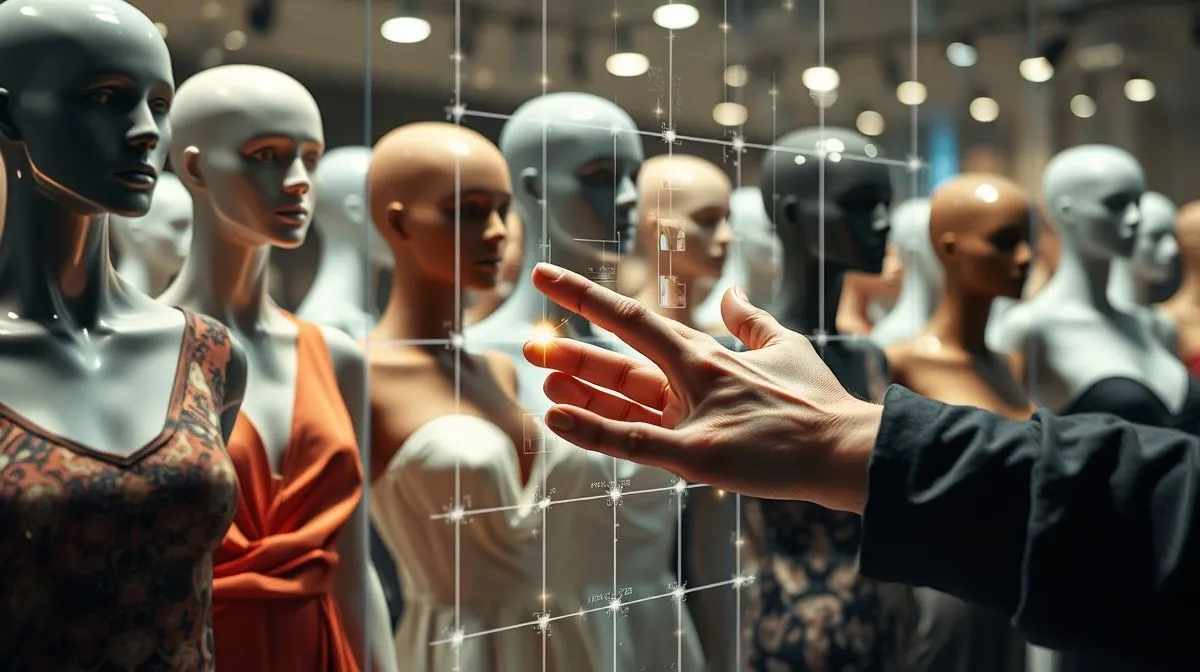
How to Mitigate AI Bias in Fashion Design and Personalization?
For over 15 years, navigating the intricate landscape of fashion technology, I've witnessed firsthand the transformative power of AI. From accelerating design processes to revolutionizing customer personalization, AI has become an indispensable tool. Yet, amidst this innovation, I've also observed a silent, insidious threat emerge: algorithmic bias. It's a challenge that, if left unaddressed, can not only perpetuate societal inequalities but also severely damage brand reputation and erode consumer trust.
The pain point is real. Fashion, by its very nature, is about identity, expression, and inclusivity. When AI systems, trained on flawed or unrepresentative data, start making decisions about what designs are 'popular,' who gets what 'personalized' recommendation, or even what body types are 'standard,' they risk alienating vast segments of the population. This isn't just a technical glitch; it's an ethical imperative. We're talking about systems that can inadvertently exclude, stereotype, and reinforce harmful biases, leading to missed market opportunities and a less vibrant, less equitable industry.
In this definitive guide, I'll draw upon my extensive experience to provide you with a robust framework. You'll learn not just what AI bias is, but how it manifests specifically within fashion design and personalization, and crucially, how to mitigate AI bias in fashion design and personalization through actionable strategies. We'll delve into practical steps, real-world analogies, and expert insights designed to help you build ethical, inclusive, and truly innovative AI systems that serve all consumers.
Understanding the Roots of AI Bias in Fashion
Before we can fix a problem, we must understand its origins. In fashion technology, AI bias isn't a singular issue; it's a multi-faceted challenge stemming primarily from three areas: data, algorithms, and human interaction. Think of it as a tree: the visible bias is the fruit, but the roots are hidden deeper.
Data Bias: The Foundation of Flaws. Most AI systems are only as good as the data they're trained on. In fashion, this often means historical data – past sales, design trends, body measurements, and even editorial imagery. If this historical data disproportionately represents certain demographics (e.g., specific body types, skin tones, or cultural styles), the AI will learn and amplify these biases. For instance, if a design AI is trained predominantly on images of slender, light-skinned models, it might struggle to generate or recommend designs that flatter diverse body shapes or complexions. This leads to a narrow vision of 'fashion' dictated by past limitations, not future possibilities.
"Data is the new oil, but if that oil is polluted from the source, every engine it fuels will eventually seize. In AI, biased data is a toxic asset."
Algorithmic Bias: Unintended Consequences. Even with good data, algorithms themselves can introduce bias. This happens when the underlying assumptions, feature selections, or optimization objectives of the algorithm inadvertently lead to unfair outcomes. Perhaps an algorithm optimizes for 'engagement' but, in doing so, reinforces existing stereotypes. Or, an AI designed for 'fit prediction' might perform poorly for less represented body types simply because its model parameters were never adequately challenged with that diversity during training. These are not malicious intentions, but rather blind spots in development.
User Interaction Bias: The Feedback Loop. Finally, bias can be reinforced through user interaction. If an AI recommends a limited range of products based on initial biased data, users might only engage with those limited options, thus providing feedback that reinforces the AI's narrow perspective. It becomes a self-fulfilling prophecy, where the AI's recommendations narrow the user's choices, which then narrows the AI's understanding, creating a vicious cycle of exclusion.
The Critical Role of Diverse and Representative Datasets
In my journey through fashion tech, I've seen countless projects falter because they underestimated the power of truly diverse data. It's the bedrock of ethical AI. To effectively mitigate AI bias in fashion design and personalization, your data must reflect the rich tapestry of human diversity. This goes beyond just race or gender; it includes age, body shape, cultural background, socio-economic status, and even regional aesthetic preferences.
Here are actionable steps to cultivate a truly representative dataset:
- Conduct a Comprehensive Data Audit: Before you even think about new data, understand your existing data. What are its demographic gaps? What historical biases does it contain? Use statistical tools to identify underrepresented groups or overemphasized features. For example, if your sizing data disproportionately favors smaller sizes, or your color palette is limited, you've found a starting point.
- Prioritize Ethical Data Collection: Actively seek out data that fills the identified gaps. This might involve partnering with diverse communities for data collection, ensuring consent is explicit, and compensating participants fairly. Consider crowdsourcing efforts specifically targeting underrepresented groups. Remember, quality and ethical sourcing trump quantity.
- Leverage Data Augmentation and Synthesis (Cautiously): When real-world data is scarce, techniques like data augmentation (e.g., slightly altering existing images to create variations) or synthetic data generation (creating artificial data that mimics real-world characteristics) can help. However, be extremely cautious with synthetic data; if the generator itself is biased, it will simply propagate the bias. Ensure synthetic data is validated against real-world diversity metrics.
- Implement "Bias Bounties" or Red Teaming: Engage external experts or dedicated internal teams to actively try and "break" your models by exposing them to edge cases or inputs that are likely to trigger biased responses. This proactive approach helps uncover hidden biases before deployment.
According to a McKinsey report on AI bias, "diverse training data is foundational for reducing bias and improving model performance across different demographic groups." This isn't just about ethics; it's about building more robust, accurate, and commercially viable AI solutions.
Implementing Robust Algorithmic Fairness Techniques
Even with pristine data, the algorithms themselves need careful design and scrutiny to mitigate AI bias in fashion design and personalization. Algorithmic fairness techniques are methods applied during or after model training to ensure equitable outcomes across different groups. This isn't about making all outputs identical, but ensuring that the decision-making process is fair and does not disadvantage specific groups.
- Pre-processing Techniques: These methods modify the training data *before* it's fed into the model. Examples include re-weighting samples to give more importance to underrepresented groups, or 'disparate impact removers' that transform features to reduce their correlation with sensitive attributes while preserving utility.
- In-processing Techniques: These are integrated into the model's training phase. They modify the learning algorithm itself to incorporate fairness constraints. For instance, an algorithm might be penalized not just for prediction errors but also for disparities in error rates across different demographic groups. Adversarial de-biasing, where a discriminator tries to predict sensitive attributes from the model's output, forcing the model to become independent of those attributes, is a powerful example.
- Post-processing Techniques: Applied *after* the model has made its predictions, these methods adjust the outputs to achieve fairness goals. For example, threshold adjustment can be used to ensure that the false positive rate or false negative rate is similar across different groups, even if it means slightly altering some individual predictions.
The challenge lies in choosing the right fairness metric (e.g., demographic parity, equalized odds, individual fairness) as they often involve trade-offs between fairness and accuracy. It requires a deep understanding of your specific fashion application and its societal implications. Tools like IBM's AI Fairness 360 are invaluable open-source toolkits that provide a suite of fairness metrics and bias mitigation algorithms for developers.
Establishing Transparent and Explainable AI (XAI) Frameworks
One of the most powerful tools in our arsenal against bias is transparency. If we can't understand *why* an AI made a particular decision, how can we possibly identify and correct its biases? Explainable AI (XAI) is not just a buzzword; it's a critical component for building trust and accountability, especially in a creative and personal industry like fashion.
XAI aims to make AI models more interpretable. This means being able to answer questions like: "Why was this particular outfit recommended?" or "What features of this design led the AI to classify it as 'trendy'?" For fashion designers, marketers, and most importantly, consumers, this transparency is paramount.
- Feature Importance: Simple XAI techniques can show which input features (e.g., color, fabric, silhouette, historical purchase data) contributed most to an AI's decision. If an AI consistently relies on a feature that is a proxy for a sensitive attribute (like recommending only certain styles based on a user's inferred age group), it's a red flag.
- LIME (Local Interpretable Model-agnostic Explanations) & SHAP (SHapley Additive exPlanations): These advanced techniques provide local explanations for individual predictions. They can tell you, for example, that for a specific customer, the AI recommended a certain dress primarily because of their past preference for floral patterns and a recent search for eco-friendly materials, rather than their gender or perceived body type.
- Communicating AI Decisions: Beyond technical explanations, the key is to translate these insights into understandable language for human stakeholders. Imagine an AI-powered design tool that not only suggests modifications but also explains its rationale: "The AI suggests widening the sleeve based on current trends for comfort and a slight increase in projected sales for this silhouette in our target demographic."
Case Study: Chic AI & Transparent Personalization
Chic AI, a burgeoning online fashion retailer, was struggling with customer churn despite their advanced personalization engine. User feedback indicated a lack of trust and sometimes "creepy" recommendations. By implementing XAI frameworks, they started providing a "Why This Pick?" button next to each personalized recommendation. Clicking it revealed the top 3-5 factors influencing the suggestion (e.g., "Based on your preference for minimalist designs," "Similar to your recent purchase of a linen top," "Popular among users who browse sustainable brands"). This transparency led to a remarkable 15% increase in customer satisfaction and a 10% reduction in returns, proving that trust, built through explainability, directly impacts the bottom line.
Fostering Human-in-the-Loop Oversight and Ethical Review Boards
As much as we rely on AI, the human element remains irreplaceable. To effectively mitigate AI bias in fashion design and personalization, we must integrate human intelligence and ethical judgment at critical junctures. This "human-in-the-loop" approach acknowledges that while AI excels at pattern recognition and scale, humans bring nuanced understanding, empathy, and ethical reasoning that machines currently lack.
My experience has taught me that the most successful AI implementations are those where humans and AI collaborate, rather than one replacing the other. Here's how to institutionalize this:
- Define Clear Human Oversight Points: Identify specific stages in your AI pipeline where human review is essential. This could be at the data labeling stage, during model validation, or before a personalized recommendation goes live. For instance, a human stylist might review the top 10 AI-generated outfit recommendations for a high-value customer before sending them out, ensuring they align with brand values and nuanced customer understanding.
- Establish an Ethical AI Review Board: Create a cross-functional committee comprising designers, data scientists, ethicists, legal experts, and even consumer representatives. This board's mandate should be to review AI projects for potential biases, ethical implications, and adherence to responsible AI principles. They act as a crucial check and balance, providing an external perspective often missed by development teams focused solely on technical performance.
- Train Human Reviewers on Bias Detection: Simply having humans in the loop isn't enough; they must be equipped to spot bias. Provide training on common types of algorithmic bias, the specific ways bias can manifest in fashion (e.g., narrow aesthetic definitions, body shaming), and how to use XAI tools to investigate suspicious outcomes.
As Forbes Technology Council often highlights, "Human-in-the-loop AI is not just about correcting errors; it's about instilling human values and ethical considerations into automated systems."
Personalization Beyond Demographics: Focusing on Behavioral Nuances
True personalization in fashion moves beyond simplistic demographic buckets. The danger of AI bias in fashion design and personalization often arises when systems rely too heavily on broad categories like "female, 25-35" or "male, athletic build." People are far more complex and multifaceted than their demographic labels suggest. Ethical and effective personalization delves into behavioral nuances, psychographics, and individual preferences.
- Focus on Intent and Behavior: Instead of inferring preferences from demographics, analyze actual behaviors: what styles do they browse? What materials do they prefer? Do they consistently look for sustainable options? Do they save outfits to wish lists but rarely purchase? These actions reveal far more about individual taste than broad categories.
- Embrace Intersectionality: Recognize that individuals hold multiple identities simultaneously. A woman might be 50, a professional, a marathon runner, and deeply passionate about avant-garde fashion. An AI that only sees '50-year-old woman' will likely miss the mark. Develop models that can understand and integrate these intersecting preferences without falling into stereotypical traps.
- Allow for Self-Expression and Discovery: Personalization shouldn't be a filter bubble. Provide mechanisms for users to explicitly state preferences, provide feedback on recommendations, and explore styles outside their predicted 'norm'. This empowers users and allows the AI to learn from explicit input, not just implicit, potentially biased, historical patterns.
"Authentic personalization isn't about predicting what someone *should* like based on who they are, but about understanding what they *do* like, and helping them discover more of it, and even challenge their own perceptions."
This approach naturally helps mitigate AI bias in fashion design and personalization by shifting the focus from group characteristics to individual desires, fostering a more inclusive and relevant experience.
Continuous Monitoring, Auditing, and Feedback Loops
AI bias is not a static problem that you solve once and then forget about. It's a dynamic challenge. As data evolves, as societal norms shift, and as your AI models interact with users, new biases can emerge or existing ones can resurface. Therefore, continuous monitoring, regular auditing, and robust feedback loops are essential components of an ethical AI strategy in fashion.
Think of it as routine maintenance for a high-performance vehicle; you wouldn't just build it and expect it to run perfectly forever without checks.
- Implement Automated Bias Detection Tools: Integrate tools and dashboards that continuously monitor your AI models for fairness metrics and performance across different demographic or behavioral segments. Set up alerts for significant deviations or performance drops for specific groups. These tools can flag potential issues in real-time or near real-time, allowing for swift intervention.
- Schedule Regular Manual Audits: Beyond automated checks, conduct periodic deep-dive manual audits. This involves human experts reviewing model outputs, analyzing specific cases of concern, and re-evaluating the underlying data and algorithmic assumptions. These audits should be performed by individuals or teams not directly involved in the model's development to ensure objectivity.
- Establish Robust User Feedback Mechanisms: Create easy and accessible ways for users to provide feedback on AI-driven experiences. If a personalization engine recommends something irrelevant, biased, or offensive, users should have a clear path to report it. Analyze this feedback systematically to identify recurring issues or patterns of bias that automated tools might miss. This direct consumer insight is invaluable for flagging subtle biases.
- Regular Model Retraining and Updating: Based on monitoring, audits, and feedback, regularly retrain and update your AI models. This isn't just about improving accuracy but specifically about integrating new, more diverse data and applying updated bias mitigation techniques. Treat AI development as an iterative process of continuous improvement, with fairness as a core performance metric.
As a McKinsey report on AI in fashion points out, "Responsible AI is not a one-time project; it’s an ongoing commitment to ethical practices throughout the AI lifecycle."
Building an Inclusive Culture within Fashion Tech Teams
Ultimately, the most sophisticated algorithms and the cleanest data sets will fall short if the teams building and deploying AI lack diverse perspectives. My strongest conviction, after years in this field, is that an inclusive culture is the bedrock upon which ethical AI is built. If your team is homogenous, their blind spots will inevitably become your AI's blind spots.
"Diversity isn't just a buzzword; it's a strategic advantage in AI development. Diverse teams build more robust, more equitable, and ultimately, more successful AI."
Here's how to foster such a culture:
- Prioritize Diversity in Hiring: Actively seek to build diverse teams across all dimensions – gender, ethnicity, age, socio-economic background, cognitive styles, and professional experience. A team comprising individuals from various backgrounds is far more likely to identify potential biases in data or algorithms than a homogenous one.
- Provide Unconscious Bias Training: Implement regular training for all team members, especially those involved in data collection, model development, and deployment. This training helps individuals recognize and challenge their own unconscious biases, which can subtly influence everything from feature selection to problem definition.
- Foster a Culture of Psychological Safety: Create an environment where team members feel safe to voice concerns about potential biases, challenge assumptions, and ask difficult ethical questions without fear of reprisal. Encourage open dialogue, debate, and critical self-reflection about the societal impact of the AI they are building.
- Integrate Ethical AI Principles into Workflow: Make ethical considerations a standard part of every project lifecycle, from ideation to deployment and maintenance. This means incorporating bias assessments into design reviews, making fairness metrics a key performance indicator, and celebrating examples of ethical AI innovation.
By investing in your people and cultivating a truly inclusive environment, you naturally empower your teams to mitigate AI bias in fashion design and personalization from the ground up, creating AI systems that reflect the diversity of the world they serve.
Frequently Asked Questions (FAQ)
Question? Can AI ever be truly unbiased in fashion? No AI system can be 100% unbiased, primarily because AI learns from human-generated data, which inherently contains societal biases. The goal isn't absolute neutrality, but rather a continuous effort to identify, measure, and mitigate existing biases, striving for fairness and equitable outcomes for all user groups. It's an ongoing process of improvement, not a destination.
Question? What's the biggest risk of unchecked AI bias in fashion personalization? The biggest risk is alienation and market exclusion. Unchecked bias can lead to AI systems that only serve a narrow demographic, ignoring the needs and preferences of diverse consumer groups. This not only erodes customer trust and harms brand reputation but also represents a massive missed market opportunity, as fashion brands fail to cater to the vast, diverse global consumer base. It can also reinforce harmful stereotypes.
Question? Is synthetic data a reliable solution for addressing data bias? Synthetic data can be a valuable tool, especially when real-world data for underrepresented groups is scarce. However, it's not a silver bullet. If the synthetic data generation process itself is trained on biased real data or incorporates biased assumptions, it can inadvertently perpetuate or even amplify existing biases. It must be used cautiously and rigorously validated against real-world diversity metrics to ensure it genuinely reduces, rather than propagates, bias.
Question? How do small fashion businesses approach mitigating AI bias without large resources? Even small businesses can take significant steps. Start by auditing your existing data for obvious gaps and actively seeking more diverse inputs. Prioritize human-in-the-loop review for critical AI decisions. Focus on simpler, interpretable AI models initially. Leverage open-source tools for bias detection and mitigation where possible. Most importantly, foster an inclusive culture within your team and listen actively to diverse customer feedback. Ethical AI is a mindset, not just a budget line item.
Question? What are the regulatory trends in AI ethics that fashion companies should be aware of? Regulatory landscapes for AI ethics are rapidly evolving globally. The EU's AI Act, for instance, categorizes AI systems by risk level, with 'high-risk' systems (which could include some personalization or design AI in fashion due to potential for harm) facing stringent requirements for data quality, transparency, human oversight, and conformity assessments. Other regions are developing similar frameworks. Fashion companies must stay informed about these regulations, as non-compliance can lead to significant penalties and reputational damage. Proactive implementation of ethical AI principles is the best defense.
Recommended Reading
- Unlock the Secrets: How to Properly Care for Your Luxury Designer Glasses
- The Ultimate Men's Capsule Wardrobe for Travel: Pack Light & Right!
- Unveiling the Secret: What is the Process of Creating a Haute Couture Gown?
- The Ultimate Secret to Effortlessly Transitioning Outfits for Busy Women
- Unlocking Feminine Style: The Essential Characteristics You Need to Know
Key Takeaways and Final Thoughts
Navigating the complex world of AI in fashion offers immense opportunities, but it comes with a profound responsibility. My years in this industry have reinforced one truth: technology, at its best, should empower and include, not exclude or stereotype. To truly mitigate AI bias in fashion design and personalization, it requires a holistic and continuous commitment.
- Data is Paramount: Invest in truly diverse, representative, and ethically sourced data. It's the foundation.
- Algorithms Need Scrutiny: Employ fairness techniques and understand the trade-offs involved.
- Transparency Builds Trust: Implement XAI to explain decisions to both internal teams and consumers.
- Humans Are Indispensable: Integrate human oversight and ethical review boards at every critical juncture.
- Personalize Thoughtfully: Move beyond demographics to understand individual behaviors and intersecting identities.
- Monitor Continuously: Bias is dynamic; regular audits and feedback loops are non-negotiable.
- Culture Drives Change: Build diverse and inclusive teams that inherently champion ethical AI.
The future of fashion is undoubtedly digital, but its heart must remain human. By consciously and proactively addressing AI bias, we don't just build better algorithms; we build a better, more equitable, and more inclusive fashion industry for everyone. This isn't just about avoiding pitfalls; it's about unlocking the full, positive potential of AI to truly celebrate the diversity of human style and identity. Embrace this challenge, and you'll not only innovate but also lead with integrity.




Your email address will not be published. Required fields are marked *