


How to Fix Subtle Fit Issues in a Client's Haute Couture Creation?
For over two decades in the rarefied world of haute couture, I've witnessed the profound impact of perfection – and the devastating consequences of anything less. A haute couture garment isn't merely clothing; it's a wearable piece of art, a culmination of countless hours of meticulous craftsmanship, exquisite materials, and an intimate understanding of the client's form and aspirations. The pursuit of an absolutely flawless fit is not just a standard; it's the very soul of this art form.
Yet, even with the most rigorous fittings and the most skilled hands, subtle fit issues can emerge. A barely perceptible drag line, a slight gape at the neckline, an imbalance in the drape – these are not minor inconveniences in haute couture; they are glaring imperfections that can undermine the garment's integrity, compromise the client's comfort, and, most critically, erode their confidence and satisfaction. The problem is often compounded by the delicate, often irreplaceable nature of couture fabrics and embellishments, making corrective measures a high-stakes endeavor.
This comprehensive guide is born from years of hands-on experience, countless hours spent perfecting the imperceptible. I will walk you through the nuanced process of diagnosing, approaching, and meticulously resolving these elusive fit challenges. You will gain actionable frameworks, real-world case studies, and expert insights that promise not just to fix a garment, but to elevate it, ensuring every haute couture creation you touch achieves absolute perfection and leaves your client utterly delighted.
The Unforgiving Canvas: Understanding Haute Couture's Unique Demands
Before we delve into solutions, it's crucial to grasp why subtle fit issues are so magnified in haute couture. Unlike ready-to-wear, where tolerances are generous, couture operates on a zero-defect principle. Every curve, every seam, every embellishment must harmonize with the wearer's body, creating a second skin that moves with grace and confidence.
The Anatomy of a Flawless Fit
A truly flawless haute couture fit goes beyond mere measurements. It encompasses:
- Balance: The garment sits perfectly on the body, with no pulling, twisting, or unevenness from any angle.
- Drape: Fabrics fall naturally, showcasing their inherent beauty without resistance or unnatural folds.
- Comfort: Despite intricate construction, the garment allows for ease of movement and feels effortless to wear.
- Proportion: Every design element, from lapel width to skirt length, is perfectly scaled to the client's physique.
- Client's Vision: The garment embodies the client's aesthetic desires and enhances their unique presence.
The materials themselves – from hand-woven silks to intricate laces and custom embroideries – often have unique characteristics that demand a different approach to alteration. They are precious, often delicate, and unforgiving of error. Understanding these foundational principles is the first step in mastering **How to fix subtle fit issues in a client's haute couture creation?**
Initial Diagnosis: The Art of the Eye and the Touch
The most critical phase in correcting a subtle fit issue is the initial diagnosis. This requires not just technical skill but an almost intuitive understanding of fabric, form, and client psychology. I've found that rushing this step inevitably leads to more problems down the line.
Consultation and Client Communication: Listening Beyond Words
Often, a client might not articulate the problem precisely. They might say, "It just doesn't feel right," or "Something is off." Your role is to translate that vague feeling into a precise technical diagnosis.
- Observe First: Before asking questions, have the client put on the garment. Observe their posture, how they move, and how the fabric behaves. Look for drag lines, pooling, gapping, or areas of tension.
- Engage Empathetically: Ask open-ended questions. "Where do you feel any discomfort?" "Does it move with you, or against you?" "How does it feel when you sit, stand, or lift your arms?"
- Tactile Assessment: Gently run your hands over the garment. Feel for areas of tightness or looseness that might not be immediately visible. Pay attention to seams, dart points, and stress areas.
- Document Meticulously: Take detailed notes, sketches, and photographs (with client permission) from multiple angles. Mark areas with fine, non-damaging chalk or silk thread.
According to a study published in the Harvard Business Review on Customer Experience, clear and empathetic communication is paramount in luxury service. This initial dialogue builds trust and ensures you’re addressing the actual issue, not just its symptom.

Precision Tools and Techniques for Subtle Corrections
The tools of the haute couturier are extensions of their hands, designed for precision and minimal intervention. When addressing subtle fit issues, the choice of tool and technique is paramount to avoid further damage or visible alterations.
The Gentle Art of Pinning and Marking
Forget standard dressmaker's pins. In couture, we use ultra-fine silk pins, often with glass heads, to avoid snagging delicate fabrics. Marking is done with specialist chalks that brush away cleanly, or, for the most precious materials, with tiny, contrasting silk thread basting stitches.
- Micro-Pinning: Use pins to gently ease or take in fabric in incredibly small increments. Aim for adjustments of millimeters, not centimeters.
- Directional Pinning: Always pin in the direction of the fabric grain to maintain its integrity and drape.
- Temporary Basting: For critical adjustments, use fine silk thread to baste the alteration by hand before making any permanent changes. This allows for easy removal and re-evaluation.
- Steam Manipulation: For slight easing or shaping, controlled steam can be a powerful, non-invasive tool, especially on natural fibers. However, extreme caution is advised, particularly with embellished or delicate materials.
Addressing Common Subtle Fit Issues: A Practical Guide
In my experience, certain subtle fit issues surface repeatedly. Knowing how to approach these with precision is key to mastering **How to fix subtle fit issues in a client's haute couture creation?**
The Pesky Gape: Necklines and Armholes
A gape, no matter how small, is a sign of imbalance. For necklines, it often indicates too much fabric or an incorrect curve. For armholes, it might mean the shoulder seam is too wide or the armhole curve is not true to the body.
- Neckline Gape: Carefully take in a tiny amount at the shoulder seam or along the neckline curve. Sometimes, adding a small, internal bust dart or strategically placed boning can resolve this without altering the exterior.
- Armhole Gape: This often requires re-shaping the armhole curve slightly or reducing the shoulder width. For very subtle issues, a small, internal pad can sometimes fill the void without visible alteration.
The Unwanted Wrinkle: Bust and Waist Draping
Horizontal wrinkles at the bust or waist often signal tightness or looseness, while diagonal drag lines point to an imbalance in the garment’s grain.
- Horizontal Wrinkles: These can indicate the garment is either too tight (stress wrinkles) or too loose (excess fabric pooling). Micro-adjusting side seams or dart intake by just a few millimeters can make a profound difference.
- Diagonal Drag Lines: These are trickier, often stemming from an incorrect grainline or uneven tension. It might require carefully unpicking a section of a seam and re-sewing it with slight easing or tightening to balance the fabric.
The Sagging Silhouette: Shoulders and Sleeves
A shoulder that sags or a sleeve that doesn't sit perfectly can ruin the entire line of a garment.
- Sagging Shoulder: Often, this means the shoulder seam is too long. Carefully take in the shoulder seam from the armhole side. Sometimes, a perfectly tailored, very thin shoulder pad can also provide the necessary lift and shape.
- Sleeve Cap Issues: Drag lines around the sleeve cap or a sleeve that appears “puffy” can be due to too much ease or an ill-fitting armhole. This requires precise re-shaping of the sleeve cap and potentially the armhole to ensure a smooth, clean insertion.
The Uneven Hemline: Achieving Perfect Balance
An uneven hemline, particularly on flowing gowns or intricate skirts, is a common subtle issue.
- Re-leveling: Have the client wear the garment with the correct undergarments and shoes. Use a hem marker or a steady eye to re-level the hem. For very delicate or embellished hems, this is done entirely by hand, often requiring individual re-attachment of elements.
- Internal Weights: For garments prone to shifting, tiny, discreet internal weights sewn into the hem can help maintain a perfect line.
| Fit Issue | Common Cause | Subtle Fix Strategy | Time Investment |
|---|---|---|---|
| Gape at Neckline | Excess fabric, incorrect shoulder slope | Increase dart depth, narrow shoulder seam, add internal support | Medium |
| Horizontal Waist Wrinkles | Waistline too tight or too loose | Micro-adjust side seams, re-balance dart placement | Medium |
| Sleeve Drag Lines | Incorrect sleeve cap height or armhole curve | Re-shape armhole, adjust sleeve ease, fine-tune shoulder pad | High |
| Sagging Shoulder | Shoulder seam too long, poor internal structure | Shorten shoulder seam from armhole, insert custom pad | Medium |
| Uneven Hemline | Improper measuring, fabric stretch | Re-level by hand, add discreet internal weights | High |
The Delicate Dance of Seam Adjustments and Fabric Manipulation
Once the diagnosis is complete, the actual work of adjustment begins. This is where a couturier's deep understanding of fabric behavior, garment construction, and an almost surgical precision comes into play. The goal is always to make the alteration invisible, as if the garment was always meant to fit that way.
Working with Delicate Fabrics: Silks, Laces, and Embellishments
Each fabric type presents its own set of challenges. Heavy silks might hold creases, while chiffon can stretch or distort. Laces and heavily embellished fabrics require painstaking, often individual, re-attachment of motifs or beads.
- Hand-Stitching is Paramount: Machine stitching, while faster, lacks the control and delicacy required for subtle haute couture adjustments. Every stitch should be precise, strong, and virtually invisible.
- Understanding Grainlines: Always respect the fabric's grain. Altering against the grain can lead to permanent distortion.
- Easing vs. Gathering: Learn the difference and when to apply each. Easing involves subtly distributing fullness over a longer seam, while gathering creates deliberate pleats.
- Underlying Structure: Often, a subtle fit issue is a symptom of a problem in the garment's internal structure – the lining, interlining, or boning. Addressing these foundational elements first can resolve external issues without touching the outer fabric.
"In haute couture, every stitch tells a story of intention. When correcting a fit, we're not just moving fabric; we're re-writing a chapter to perfection, ensuring the original narrative of design integrity remains unblemished."
This philosophy guides every hand movement, every decision. It's about preserving the original vision while achieving an even higher degree of perfection. For more insights into the technicalities of fabric manipulation, I often refer to resources like The Textile Institute.
Case Study: Rescuing a Red Carpet Gown from a Subtle Snag
Case Study: The Empress's Gown and the Imperceptible Drag Line
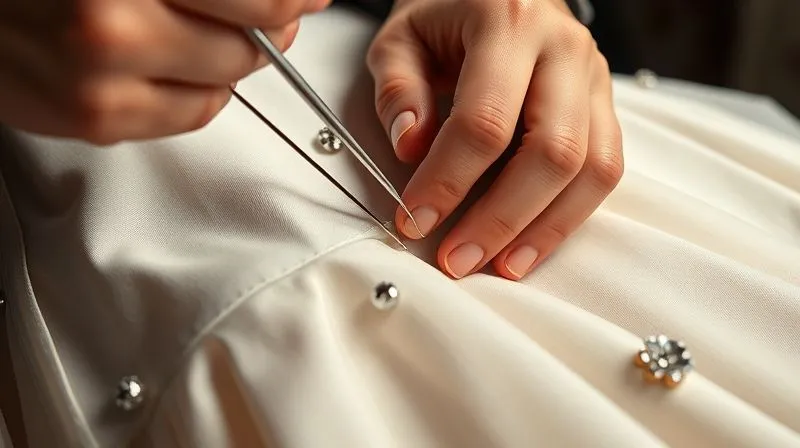
I recall a particularly challenging situation with a client preparing for a major international gala. Her bespoke gown, a masterpiece of hand-embroidered silk organza, had developed a barely perceptible drag line across the lower back after a final fitting. It wasn't obvious to an untrained eye, but to mine, it screamed imperfection. The client, while initially hesitant to point it out, confessed to a slight discomfort when seated. My team and I meticulously re-examined the internal construction. We discovered that a tiny, almost invisible shift in the lining's grain during an earlier adjustment was causing the outer fabric to pull. Instead of deconstructing the entire back, we carefully unpicked a small section of the lining, re-eased it by hand, and re-secured it with micro-stitches, ensuring the outer organza now draped flawlessly. The client was ecstatic, noting not only the improved comfort but also the enhanced visual flow of the garment. This experience reinforced the importance of relentless attention to internal construction and the understanding that true haute couture perfection lies in the unseen details as much as the seen.
The Re-fitting and Client Approval Process
After the meticulous adjustments, the re-fitting is a moment of truth. This is where the client experiences the 'fixed' garment, and your work truly shines. It's not just about the fit, but the entire experience of presenting a perfected creation.
The Final Polish: Pressing, Steaming, and Presentation
Even the most perfectly altered garment can look unfinished without the final touches. Pressing and steaming are an art in themselves, especially for couture fabrics. Use specialized equipment and techniques to ensure every seam is crisp, every curve is smooth, and the fabric drapes as intended.
- Controlled Steam: Use a professional garment steamer with distilled water. Hold the steamer at a safe distance and allow the steam to relax the fabric fibers. Avoid direct contact, especially with embellishments.
- Pressing Cloths: Always use appropriate pressing cloths to protect delicate fabrics from scorching or shine.
- Specialized Hangers: Present the garment on a padded, custom hanger, ensuring its shape is maintained.
- Client Presentation: Guide the client through the re-fitting. Point out the subtle improvements without overstating them. Let the garment speak for itself. Observe their reaction and ensure their absolute satisfaction. This is crucial for understanding **How to fix subtle fit issues in a client's haute couture creation?** not just technically, but experientially.
Remember, the goal is not just to fix a problem but to reaffirm the client's investment in unparalleled quality and service. As luxury brand strategist Robert Burke often emphasizes, the experience of acquiring and wearing a luxury item is as important as the item itself.

Beyond the Stitch: Cultivating a Reputation for Perfection
Mastering the art of fixing subtle fit issues in haute couture is more than a technical skill; it's a testament to your dedication to excellence and your understanding of the profound trust clients place in you. Every perfectly executed alteration reinforces your reputation and strengthens the bond with your clientele.
In the highly competitive and exclusive world of haute couture, reputation is everything. Word-of-mouth, often from the most discerning clients, is the most powerful marketing tool. A client who experiences your meticulous attention to detail and your unwavering commitment to perfection will not only return but will also become an ambassador for your craft. This level of service is what truly defines luxury. For further reading on client satisfaction in luxury industries, the insights from Forbes' luxury sector articles can be incredibly illuminating.
The journey of a haute couturier is one of continuous learning and refinement. Each subtle fit challenge is an opportunity to deepen your expertise, hone your craft, and further cement your legacy as a master of precision tailoring. Embrace these challenges, for they are the crucible in which true mastery is forged.
Frequently Asked Questions (FAQ)
Q: How do I distinguish a subtle fit issue from a deliberate design feature in haute couture? A: This requires a deep understanding of the designer's aesthetic and the garment's original intent. A fit issue typically causes discomfort, restricts movement, or creates unnatural pulls/wrinkles against the body's natural lines. A design feature, while possibly unconventional, will be intentional, balanced, and contribute to the garment's overall artistic statement. Always refer to original sketches, if available, and communicate openly with the client about their expectations versus the design's specific characteristics.
Q: What's the biggest mistake couturiers make when attempting to fix subtle fit issues? A: The biggest mistake is often rushing the diagnosis or making assumptions. Another common error is using aggressive or irreversible techniques (e.g., cutting fabric prematurely, using machine stitches where hand-stitching is required) before fully understanding the root cause. My advice is always to approach with minimal intervention, using temporary basting and careful observation, and to consider the garment's entire internal structure, not just the visible outer shell.
Q: Can all subtle fit issues be fixed without visible alteration? A: In most cases, yes, with enough skill and patience. The goal in haute couture is always for the alteration to be invisible. This often involves working on the garment's interior, adjusting linings, interlinings, or even reshaping internal boning. Sometimes, very clever fabric manipulation, easing, or the strategic placement of a tiny, invisible dart can resolve an issue without any outward sign of intervention. It requires an advanced understanding of garment engineering.
Q: How do I handle a client who is overly critical or unsure of what they want regarding fit? A: Patience, empathy, and clear communication are key. Guide them through the fitting process, asking specific questions about comfort and movement rather than just “Do you like it?” Use a mirror to help them visualize the changes. Sometimes, offering two slightly different options (e.g., pinning in two ways) can help them articulate their preference. Reassure them that perfection takes time and that your shared goal is their ultimate satisfaction. Establishing trust from the outset is paramount.
Q: What internal garment structures are most critical for fit adjustments in haute couture? A: The foundation of a haute couture garment – including its lining, interlining, boning, and any internal support structures like bustiers or corsets – is often more critical than the outer fabric for achieving and maintaining a perfect fit. Issues with these internal elements can manifest as subtle external fit problems. Adjusting these hidden layers first can often resolve visible issues without needing to touch the precious outer fabric. Understanding the symbiotic relationship between the internal and external components is fundamental to expert couture tailoring. For more technical details on internal garment construction, I recommend exploring academic textiles and fashion design journals from institutions like London College of Fashion.
Key Takeaways and Final Thoughts
The art of fixing subtle fit issues in a client's haute couture creation is a definitive hallmark of a true master. It demands not just technical prowess but an unwavering commitment to perfection, a deep understanding of materials, and empathetic client communication. Here are the critical takeaways:
- Diagnosis is Paramount: Invest time in meticulous observation and empathetic listening to accurately identify the root cause of the fit issue.
- Precision Over Speed: Every adjustment, no matter how small, requires surgical precision and the use of appropriate, delicate tools and hand-stitching techniques.
- Understand Fabric and Structure: Respect the unique properties of couture fabrics and recognize that internal garment structures often hold the key to external fit issues.
- Communication Builds Trust: Guide your client through the process, ensuring their comfort and satisfaction are at the forefront of every decision.
- Invisibility is Key: The ultimate goal is an alteration so seamless it appears as though the garment was always perfect.
As couturiers, we are guardians of an extraordinary tradition, tasked with creating and maintaining garments that transcend mere fashion. By embracing these principles, you not only elevate your craft but also solidify your reputation as an artisan dedicated to the highest echelons of sartorial excellence. May your hands be steady, your eye true, and your pursuit of perfection unending. The journey to flawless fit is a challenging one, but its rewards – the client's joy and the garment's enduring beauty – are immeasurable.
Recommended Reading
- Effortless Style: Comfortable Everyday Outfits for Busy Moms
- 7 Proven Strategies: Minimize Womenswear Seasonal Overstock Markdown Losses
- 7 Pillars: Preserving High-End Fashion Exclusivity in Digital Spaces
- 6 Ways to Unmask Greenwashing in 'Cruelty-Free' Beauty Claims
- Top Picks: Discover the Best Contemporary Urban Streetwear Brands Now!



Your email address will not be published. Required fields are marked *