

Unlocking the Secrets: How to Authenticate Premium Exotic Leather
Imagine acquiring a breathtaking handbag, a pair of luxurious boots, or a distinguished wallet, all crafted from what appears to be rare and exquisite exotic leather. The allure of these materials—be it the unique scales of an alligator, the distinctive bumps of an ostrich, or the mesmerizing patterns of a python—is undeniable, embodying status, craftsmanship, and a connection to the wild. Yet, a growing concern looms over this opulent market: the pervasive presence of sophisticated counterfeits.
The challenge of how to authenticate premium exotic leather is more pressing than ever. As demand for these materials soars, so does the ingenuity of fraudsters, creating convincing fakes that can deceive even discerning eyes. Investing in a piece of exotic leather is not merely a purchase; it's often a significant investment, a statement of personal style, and sometimes, a legacy piece. Without the proper knowledge, one risks not only financial loss but also inadvertently supporting unethical practices.
This comprehensive guide is meticulously crafted to empower you with the expert knowledge and practical skills required to confidently identify genuine premium exotic leather. By the end of this reading, you will understand the unique characteristics of various exotic hides, master essential authentication techniques, learn to spot common red flags, and navigate the complexities of ethical sourcing, ensuring your investments are both authentic and responsible.
The Allure and Enduring Value of Exotic Leather
For centuries, exotic leathers have captivated humanity with their unparalleled beauty, durability, and scarcity. Unlike common cowhide, these materials offer distinctive textures, patterns, and a narrative that speaks of wild origins and masterful craftsmanship. Their unique appeal contributes significantly to their premium price point and desirability in the luxury market.
What Defines 'Exotic' in the World of Leather?
The term 'exotic leather' typically refers to hides sourced from animals other than traditional livestock like cows, sheep, or pigs. This category encompasses a fascinating array of species, each contributing its unique epidermal structure and aesthetic to the world of fashion and accessories. The appeal lies in their rarity, the intricate natural patterns, and often, their exceptional strength and longevity.
From the iconic scales of reptiles to the distinctive follicles of birds, exotic leathers stand apart. They are not simply materials; they are canvases of nature's artistry, transformed by skilled artisans into objects of desire. Understanding what makes each type unique is the first step in appreciating and authenticating them.
Why Authenticity Matters: Beyond Just the Price Tag
The importance of authenticating premium exotic leather extends far beyond merely ensuring you get what you pay for. Firstly, there's the significant financial aspect; genuine exotic leather commands a high price due to its rarity, the complex tanning processes, and the specialized craftsmanship involved. A counterfeit, no matter how convincing, holds only a fraction of this value.
Secondly, ethical considerations play a crucial role. The trade of exotic animal products is heavily regulated by international conventions like CITES (Convention on International Trade in Endangered Species of Wild Fauna and Flora) to prevent poaching and ensure sustainable sourcing. Purchasing a fake might seem harmless, but it inadvertently supports a black market that often exploits both animals and the environment. Authentic pieces, especially those from reputable brands, often come with documentation proving their ethical and legal origin.
Finally, there's the matter of durability and prestige. Genuine exotic leather, properly cared for, can last for decades, developing a beautiful patina over time. Fakes, typically made from embossed cowhide or synthetic materials, lack this inherent resilience and age poorly, quickly losing their luster and integrity. Owning an authentic piece is a testament to quality, responsible luxury, and an appreciation for true artistry.
Understanding Common Exotic Hides: Characteristics and Nuances
Each type of exotic leather possesses distinct characteristics that serve as primary indicators of its authenticity. Familiarizing yourself with these unique features is paramount for accurate identification.
Alligator and Crocodile: The Scale Patterns and Umbilical Scar
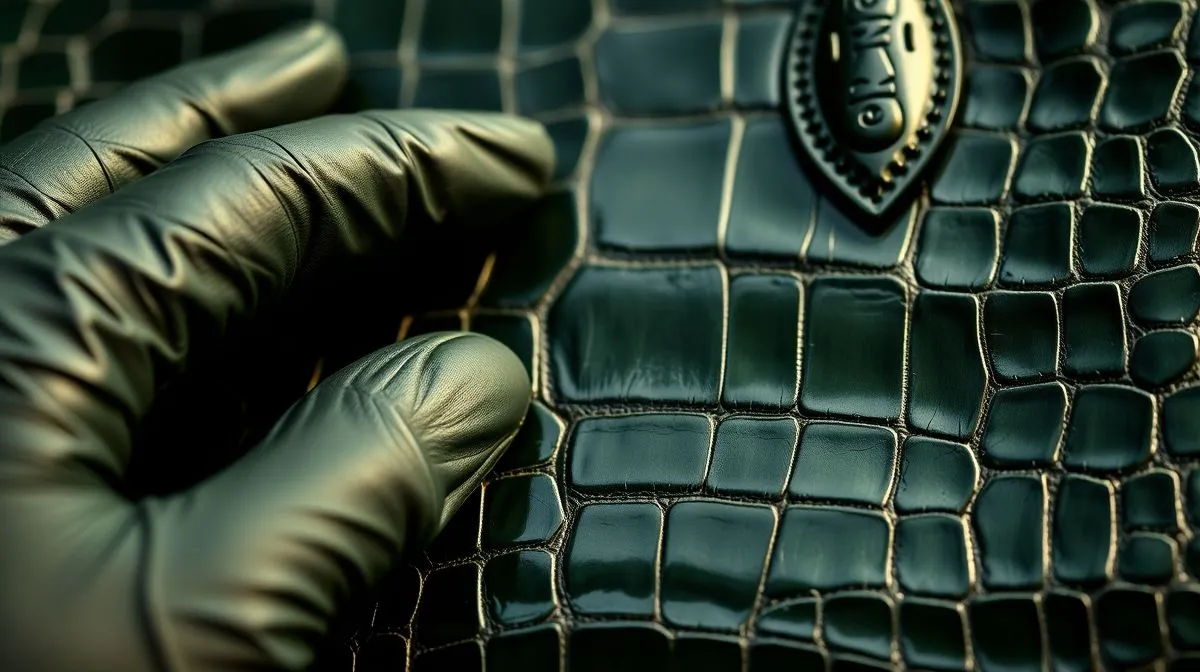
Alligator and crocodile leathers are among the most coveted, known for their prominent, rugged scales. While often confused, subtle differences exist. Genuine alligator leather (typically from the American Alligator, Alligator mississippiensis) features irregular, asymmetrical scales that are less uniform and more rounded than crocodile scales, especially across the belly. A key identifying feature is the presence of a small, web-like umbilical scar, unique to each animal, usually found in the center of the belly cut. This scar is a definitive sign of genuine alligator leather and cannot be replicated by embossing.
Crocodile leather, on the other hand, often exhibits more symmetrical and squarish scales, particularly from the Caiman or Saltwater Crocodile. While they also have osteoderms (bony plates under the scales), their arrangement and prominence differ. The scales on the flanks tend to be smaller and more rounded, transitioning to larger, more rectangular shapes on the belly. Neither alligator nor crocodile leather will have a perfectly uniform pattern; natural variations and imperfections are expected and are a sign of authenticity. Learn more about the American Alligator on Wikipedia.
Ostrich: The Distinctive Quill Bumps
Ostrich leather is instantly recognizable by its unique pattern of raised bumps, known as 'quill marks' or 'follicles.' These are the points where the bird's feathers were plucked. Genuine ostrich leather will have these quill marks concentrated in the center, typically forming a distinct pattern, while the edges and legs of the hide will be smooth. The bumps should feel firm and distinct to the touch, not merely pressed or embossed onto the surface.
The texture of ostrich leather is remarkably soft and supple, yet incredibly durable due to its natural oils. Fakes often attempt to replicate the quill marks by pressing a pattern onto cowhide, but these imitations usually feel flat, lack the depth, and often have an unnaturally uniform distribution of 'bumps' across the entire surface. The genuine article's texture is uneven and organic.
Python and Snake Skin: Unique Scales and Belly Patterns
Python and other snake skins are celebrated for their intricate, often dazzling scale patterns and vibrant natural coloration. Authenticating them relies heavily on observing the individual scales. Genuine snake skin will have scales that are distinct, overlapping, and lift slightly at the edges, giving the leather a unique, almost three-dimensional texture. You should be able to gently lift a scale with your fingernail without damaging the material.
The belly scales are typically larger and more rectangular, transitioning to smaller, more intricate patterns on the sides and back. The patterns and color variations will be organic and non-repetitive, reflecting the natural markings of the individual snake. Counterfeits often have a printed pattern that repeats perfectly or scales that are simply embossed and do not lift, feeling smooth and flat to the touch. The 'grain' will appear too perfect, lacking the natural irregularities.
Stingray: The Calcified Pearl (Crown) and Granular Texture
Stingray leather is truly unique, characterized by its highly durable, calcified, bead-like texture. This leather is exceptionally tough, almost like a mosaic of tiny pearls. The most definitive authenticating feature is the 'crown' or 'eye' – a natural, diamond-shaped, calcified remnant of the stingray's dorsal fin, typically located near the center of the hide. This crown is unique to each stingray and is virtually impossible to replicate convincingly in a fake.
The granular surface of genuine stingray leather should feel hard and somewhat abrasive, like tiny pebbles. It should not feel smooth or rubbery. The individual 'pearls' should vary slightly in size and shape, reflecting a natural formation. Imitations often use a resin coating or embossed material that lacks the true hardness and irregular texture of authentic stingray, and they will invariably miss the distinct natural crown.
Lizard: Small, Uniform Scales and Fine Grain
Lizard leather, commonly sourced from monitor lizards, is known for its small, uniform, and often highly symmetrical scales. The texture is generally fine and smooth, with a subtle sheen. The scales are typically arranged in elegant, geometric patterns, either elongated rectangles or small, rounded squares, depending on the cut and species. Unlike snake skin, lizard scales do not typically lift at the edges.
When authenticating lizard leather, look for the natural variations in the scale patterns and coloration. While uniform, they should not be perfectly identical across the entire piece. Fakes often use embossed cowhide with a pattern that feels too flat and repetitive, lacking the subtle depth and natural variation found in genuine lizard skin. The back of the leather might also offer clues, as genuine hides often show a consistent, natural suede-like texture.
The Expert's Toolkit: Primary Authentication Methods
Beyond understanding the specific characteristics of each hide, several universal techniques can help you discern authenticity. These methods combine sensory inspection with a keen eye for detail and craftsmanship.
The Touch Test: Feel and Flexibility
Genuine exotic leather possesses a unique tactile quality that is difficult for fakes to replicate. It should feel supple and soft, yet robust and resilient. For reptilian leathers, the scales should have a natural, slightly raised texture, allowing you to feel the individual scale patterns rather than a flat, uniform surface. Ostrich leather should feel soft and pliable, with the quill marks standing out distinctly.
Counterfeits often feel rigid, plasticky, or unnaturally smooth. They may lack the natural give and flexibility that real leather offers. Over time, genuine leather develops a rich patina and becomes even softer, while fakes tend to crack, peel, or stiffen, revealing their synthetic nature.
The Visual Inspection: Grain, Pores, and Imperfections
A thorough visual examination is perhaps the most critical step in how to authenticate premium exotic leather. True exotic leather, being a natural product, will exhibit subtle imperfections, variations in grain, and unique patterns. No two pieces will be exactly alike, even from the same animal. Look for natural wrinkles, slight variations in scale size or alignment, and minor blemishes that are indicative of a living skin.
Examine the pores and follicles. Genuine leather has visible, albeit sometimes tiny, pores. Fakes, especially those made from synthetic materials, will often have a uniform, unnatural sheen or a printed pattern that lacks depth and genuine texture. Embossed leathers might show a repetitive pattern that looks too perfect, or a lack of deep impression where the pattern was pressed onto the surface.
The Smell Test: Genuine Leather Aroma
Genuine leather has a distinct, earthy, and sometimes slightly musky aroma that is difficult to mimic. This smell is a result of the tanning process and the natural oils in the hide. It's often described as rich, warm, and natural. Synthetics or faux leathers, conversely, may have a chemical, plasticky, or rubbery smell. Some fakes might even try to mask their true scent with artificial fragrances, but these usually dissipate quickly or smell overtly perfumed.
While not foolproof on its own, the smell test can be a strong supporting indicator when combined with other methods. A piece that smells strongly of chemicals or has no discernible scent should raise a red flag.
The Water Drop Test (Use with Caution)
This test should be used with extreme caution and ideally on an inconspicuous area, as it can potentially stain or damage some types of exotic leather. Genuine leather, being porous, will absorb a small drop of water within a few seconds, causing the area to darken temporarily. The water will eventually evaporate, and the color will return to normal.
Faux leather or highly treated genuine leather will typically cause the water to bead up and sit on the surface, as it is non-porous. However, many genuine exotic leathers are treated with water-resistant finishes to protect them, which might cause the water to bead up even on an authentic piece. Therefore, rely on this test only as a secondary indicator and with great care.
Edge Work and Stitching: Signs of Craftsmanship
The quality of the finishing, particularly the edges and stitching, can reveal a great deal about authenticity. Premium exotic leather goods are typically handcrafted by skilled artisans. This means the edges should be meticulously finished, either by burnishing, painting, or folding, creating a smooth, clean line. The stitching should be even, tight, and consistent, with no loose threads or crooked lines.
Fakes often exhibit poor craftsmanship in these areas. Look for raw, unfinished edges, sloppy paint application, uneven stitching, or synthetic threads that fray easily. These details are labor-intensive to perfect, and counterfeiters often cut corners here, as they are less visible than the main surface of the leather.
Hardware and Lining: Often Overlooked Clues
Authentic luxury items made with exotic leather pay attention to every detail, including the hardware and interior lining. Hardware (zippers, buckles, clasps) should feel substantial, heavy, and well-finished, often engraved with the brand's logo. It should operate smoothly without sticking or feeling flimsy. The lining should be made of high-quality materials, such as suede, fine leather, or durable fabric, and meticulously sewn.
Counterfeit items often use cheap, lightweight, or discolored hardware that feels hollow or looks poorly plated. The lining might be made of thin, synthetic material, poorly stitched, or even feature incorrect branding. These seemingly minor details are often tell-tale signs of a fake, as they represent areas where counterfeiters can significantly reduce production costs.
Red Flags and Common Counterfeit Tactics
Being aware of the tricks used by counterfeiters can significantly improve your ability to identify fakes. Knowledge of these red flags is crucial in the complex process of how to authenticate premium exotic leather.
Embossed vs. Natural Grain: The Dead Giveaway
The most common method for faking exotic leather is embossing a pattern onto a cheaper material, typically cowhide or synthetic leather. The key difference lies in the depth and irregularity of the pattern. Embossed patterns will feel flat and uniform, often repeating perfectly across the surface. The 'scales' or 'quills' will not lift or show natural variation in thickness.
In contrast, genuine exotic leather will have a natural, organic depth to its texture. You can often feel the individual scales or follicles, and their arrangement will be unique and non-repetitive, just as it would be on a living animal. Look closely at the edges of the scales; on embossed leather, they often appear pressed down, while on real leather, they have a natural, slightly raised quality.
Uniformity That's Too Perfect
Nature is imperfectly perfect. Genuine exotic leathers will always display some degree of natural variation, slight blemishes, and unique irregularities in their pattern and texture. This is part of their charm and proof of their natural origin. If a piece of exotic leather appears absolutely flawless, with perfectly uniform scales or patterns across its entire surface, it should immediately raise suspicion. This level of perfection is almost impossible to achieve with real animal hides and is a hallmark of machine-made counterfeits.
Price That's Too Good to Be True
This is perhaps the most straightforward red flag. Genuine premium exotic leather is rare, difficult to source, and expensive to process and craft. Consequently, products made from it command a high price. If you encounter a deal that seems unbelievably good for an exotic leather item, it almost certainly is. Be extremely wary of significant discounts or prices that are far below market value, especially from unverified sellers or unofficial channels. Authenticity comes at a price.
Lack of Documentation (CITES, Certificates)
For many exotic leathers, particularly those from endangered or protected species like certain types of crocodile, python, or monitor lizard, international trade is regulated by CITES (Convention on International Trade in Endangered Species of Wild Fauna and Flora). Reputable sellers of genuine exotic leather goods will often provide CITES documentation or a certificate of authenticity, especially for international shipments. This document verifies the legal and ethical sourcing of the animal hide.
The absence of such documentation, especially for high-value items, is a significant red flag. While not every small item will come with individual CITES papers, reputable brands will have clear policies and traceability. Always inquire about the origin and documentation, as it reflects the seller's transparency and commitment to legal trade. Visit the official CITES website for more information on regulated species.
The Role of CITES and Ethical Sourcing
Understanding the ethical and legal framework surrounding exotic leather is not just about compliance; it's about responsible luxury. CITES plays a pivotal role in ensuring that the trade of exotic animal products is sustainable and does not threaten species survival.
What is CITES?
CITES, the Convention on International Trade in Endangered Species of Wild Fauna and Flora, is an international agreement between governments. Its aim is to ensure that international trade in specimens of wild animals and plants does not threaten their survival. It categorizes species into Appendices (I, II, III) based on their level of endangerment, with corresponding regulations on their trade. Many popular exotic leathers, such as certain species of crocodiles, pythons, and lizards, fall under CITES Appendix II, meaning their trade is permitted but strictly controlled through a system of permits and certificates.
Why CITES Documentation is Crucial for Authentication
For exotic leathers covered by CITES, proper documentation is a critical component of authenticity. A CITES permit or certificate confirms that the animal was legally sourced and that the product can be legally traded internationally. Without this documentation, even a visually authentic piece of exotic leather could be considered illegal, leading to confiscation or legal issues, especially when crossing international borders. For high-value items, always request and verify the CITES paperwork.
Ethical Considerations in Exotic Leather
Beyond legality, ethical sourcing is a growing concern for conscious consumers. Reputable brands and suppliers of exotic leather are increasingly transparent about their supply chains, ensuring animals are raised humanely (if farmed) or harvested sustainably (if wild-caught under strict quotas). They often partner with certified farms or organizations that adhere to animal welfare standards and environmental best practices. Supporting brands that prioritize ethical sourcing not only ensures authenticity but also contributes to conservation efforts and responsible industry practices. Always ask about the brand's sourcing policies and look for certifications or partnerships with animal welfare organizations.
Seeking Professional Verification
Even with extensive knowledge, some exotic leather items, especially vintage or extremely high-value pieces, can be incredibly difficult to authenticate. In such cases, professional expertise becomes invaluable.
When to Consult an Expert
You should consider consulting a professional authenticator or appraiser when:
- You are making a significant investment in a high-value exotic leather item.
- You have doubts about the authenticity of a piece, despite your own checks.
- The item is a rare or vintage piece where specific brand knowledge is required.
- You need an official appraisal for insurance purposes or resale.
Professional authenticators have access to specialized tools, extensive databases, and years of experience handling various luxury goods, including exotic leathers. They can often spot subtle nuances that an untrained eye might miss.
Reputable Appraisers and Authenticity Services
When seeking professional verification, choose reputable appraisers or authenticity services with a proven track record in luxury goods and exotic leathers. Look for certifications, positive reviews, and transparent pricing. Some high-end auction houses or luxury consignment platforms also offer authentication services. Be wary of services that promise instant, cheap authentication without thorough inspection. A genuine authentication process involves detailed examination and expert knowledge. While focused on gems, the Gemological Institute of America (GIA) provides a good model for professional authentication standards.
Practical Tips for Buyers and Collectors
Armed with the knowledge of how to authenticate premium exotic leather, consider these practical tips to make informed and confident purchases.
Research the Seller Thoroughly
Before making a purchase, especially online, thoroughly research the seller or retailer. Look for established businesses with a strong reputation, positive customer reviews, and clear return policies. Be cautious of new sellers with limited history or those operating exclusively through social media without a professional website. A reputable seller will be transparent about their products' origins and willing to answer all your questions.
Ask for Detailed Photos and Information
When buying online, request numerous high-resolution photos from various angles, including close-ups of the texture, scales, stitching, hardware, and any branding. Ask specific questions about the origin of the leather, its species, tanning process, and any available documentation (e.g., CITES papers). A legitimate seller will be happy to provide this information. If a seller is evasive or provides blurry, limited photos, it's a red flag.
Understand Return Policies
Always clarify the seller's return policy before purchasing. A reputable seller will offer a reasonable return window, especially for high-value items, allowing you time to inspect the product upon arrival and, if necessary, seek a second opinion on its authenticity. Be very cautious of 'all sales final' policies on expensive exotic leather goods, as this can indicate a seller's lack of confidence in their product's authenticity.
Start with Smaller Pieces
If you are new to collecting exotic leather, consider starting with smaller, less expensive items like wallets, cardholders, or keychains from reputable brands. This allows you to gain familiarity with the feel, look, and natural characteristics of genuine exotic leather without making a massive initial investment. As your expertise grows, you can confidently move on to larger and more valuable pieces.
Frequently Asked Questions (FAQ)
Can I authenticate exotic leather at home without special tools? Yes, many primary authentication methods, such as visual inspection, touch, and smell tests, can be performed at home with a keen eye and careful observation. However, for high-value or highly sophisticated fakes, professional verification is always recommended.
What is an umbilical scar on crocodile leather? The umbilical scar is a unique, web-like mark found on the belly scales of genuine alligator leather. It's a natural remnant from the animal's development and is a definitive indicator of authenticity for alligator hides, impossible to replicate convincingly on fakes.
Does real exotic leather always have imperfections? Yes, genuine exotic leather, being a natural product, will almost always have some degree of natural variations, slight imperfections, or unique characteristics in its pattern and texture. Uniformity that is too perfect is often a red flag for embossed or synthetic fakes.
What's the main difference between alligator and crocodile leather? The primary difference lies in the scale patterns and the presence of the umbilical scar. Alligator scales tend to be more irregular and rounded, with the distinct umbilical scar in the center. Crocodile scales are often more symmetrical and squarish, and while they have osteoderms, they lack the specific umbilical scar found on alligators.
Recommended Reading
- Are Virtual Fashion Shows Eco-Friendly? The Surprising Truth Revealed
- Dazzle on Your Day: Choosing the Best Jewelry for Strapless Dresses
- Ultimate Guide: Best Men's Skincare Routine for Sensitive Skin
- Unveiling the Hidden Truth: What Ethical Sourcing Challenges Face Haute Couture Designers?
- Unlock the Secret: How to Style Oversized Sweaters Without Looking Frumpy?
Conclusion
The world of premium exotic leather is one of exquisite beauty, unparalleled luxury, and significant investment. Learning how to authenticate premium exotic leather is not just a skill; it's an essential safeguard in a market increasingly challenged by counterfeits. By understanding the unique characteristics of each hide, employing meticulous inspection techniques, recognizing common red flags, and appreciating the importance of ethical sourcing and documentation, you empower yourself to make truly informed decisions.
Remember, authenticity lies in the details – the natural variations, the tactile feel, the subtle scent, and the quality of craftsmanship. With the insights gained from this guide, you are now equipped to navigate the luxury leather market with confidence, ensuring that your treasured pieces are not only beautiful but also genuinely and responsibly acquired. Invest wisely, cherish authentically, and let your exotic leather collection tell a true story of luxury and integrity.


Your email address will not be published. Required fields are marked *