

How to Price Custom Handmade Jewelry Pieces for Maximum Profit?
For over two decades in the dynamic world of jewelry design, I've witnessed countless talented artisans struggle with one fundamental challenge: pricing their custom handmade jewelry. It's a common pitfall, often stemming from a passionate focus on creation rather than strategic business acumen.
The problem isn't a lack of skill or dedication; it's often a deep-seated fear of overpricing, or conversely, a tendency to undervalue their own intricate work, time, and unique vision. This leads to burnout, stifled growth, and ultimately, a business that merely survives instead of thrives.
Today, I'm pulling back the curtain on the exact frameworks and insights I've developed and refined throughout my career. You'll learn not just how to cover your costs, but how to confidently price your custom handmade jewelry pieces for maximum profit, ensuring your artistry is both celebrated and financially rewarding.
Understanding Your True Costs: Beyond Materials
Before you can even begin to think about profit, you must have an ironclad understanding of your costs. This isn't just about the raw materials; it's a comprehensive look at every single expense associated with bringing a piece of custom jewelry to life.
In my experience, this is where most artisans stumble. They account for the silver and the stone, but overlook dozens of other crucial elements that chip away at their potential profit.
Direct Costs: The Tangibles
These are the expenses directly attributable to a specific piece of jewelry. They are relatively straightforward to track, but precision is key.
- Raw Materials: Metals (gold, silver, platinum), gemstones (faceted, cabochon, raw), pearls, beads, enamel, resin.
- Findings: Clasps, jump rings, ear wires, headpins, bails.
- Components: Pre-fabricated chains, settings, bezels.
- Consumables: Solder, flux, polishing compounds, saw blades, drill bits, sandpaper, pickle solution, gas for torches.
- Specialty Services: Outsourced stone setting, casting, plating, engraving specific to that piece.
- Shipping & Handling: Costs associated with receiving raw materials or sending a piece for external services.
Indirect Costs: The Hidden Drain
Often referred to as 'overhead,' these are the costs of doing business that aren't tied to a single product but are essential for your operation. Ignoring these is a surefire way to underestimate your true break-even point.
- Studio/Workshop Expenses: Rent, utilities (electricity, water, gas), internet.
- Equipment & Tools: Depreciation of larger investments like rolling mills, kilns, microscopes, specialized benches, and smaller hand tools.
- Insurance: Business liability, property insurance for your studio and inventory.
- Marketing & Sales: Website hosting, e-commerce platform fees, advertising, photography equipment, trade show fees, business cards, packaging materials (boxes, pouches, tissue paper).
- Administrative & Professional Fees: Accounting software, legal advice, professional development courses, banking fees.
- Software & Subscriptions: Design software, inventory management tools, email marketing services.
Your Most Valuable Asset: Time & Skill
This is arguably the most challenging and frequently undervalued component for handmade jewelry artisans. Your time, expertise, and unique artistic vision are not free; they are the core of your value proposition.
To calculate your labor cost effectively, you need to determine an hourly rate for yourself. Consider your skill level, years of experience, and what a highly skilled artisan in your region typically earns. Don't be shy about valuing your expertise; it's what makes your custom pieces truly special.
- Determine Your Desired Hourly Wage: What do you want to earn per hour for your skilled labor? Let's say $30-$75/hour, depending on experience and market.
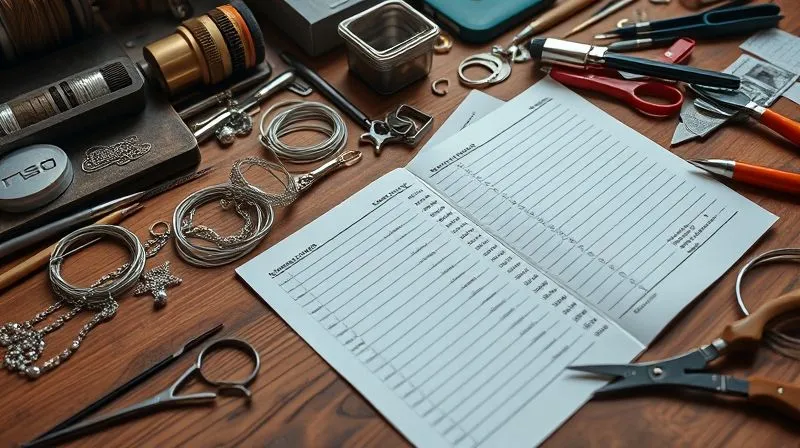
- Track Your Time Diligently: For custom pieces, track every minute spent on design, sourcing, fabrication, finishing, polishing, quality control, photography, and even client communication directly related to that piece.
- Calculate Total Labor Cost: Multiply your total hours spent by your desired hourly wage.
Once you've accounted for all these factors, you can build a comprehensive cost breakdown. This forms the bedrock of how to price custom handmade jewelry pieces for maximum profit.
| Cost Category | Example Items | Estimated Cost |
|---|---|---|
| Direct Materials | Gold wire, Sapphire, Solder | $250 |
| Consumables | Saw blades, Polishing compound | $15 |
| Outsourced Services | Casting fee | $75 |
| Labor (Fabrication) | 10 hours @ $50/hr | $500 |
| Labor (Design/Admin) | 3 hours @ $50/hr | $150 |
| Allocated Overhead | (Rent, marketing, etc.) | $60 |
| TOTAL TRUE COST | $1050 |
The Value-Based Pricing Approach: Perception & Uniqueness
While understanding your costs is non-negotiable, truly maximizing your profit involves looking beyond the numbers on a spreadsheet. This is where value-based pricing comes into play, a strategy that focuses on the perceived value your custom piece delivers to the client.
Your handmade jewelry isn't just a collection of materials; it's an expression, a story, a personalized treasure. This intangible value can, and should, command a higher price.
What is Your Brand Story Worth?
Every custom piece you create carries your unique brand identity. This encompasses your aesthetic, your craftsmanship, your ethical sourcing practices, and the narrative behind your work.
Are you known for intricate filigree, sustainable materials, or minimalist elegance? This unique selling proposition (USP) differentiates you from mass-produced items and even other artisans, justifying a premium price point. Invest in your brand story, and communicate it effectively.
Understanding Your Target Market's Willingness to Pay
Knowing your ideal client is paramount. Are they seeking an affordable fashion accessory, or a significant, heirloom-quality investment? Researching your target market's demographics, psychographics, and purchasing habits will reveal their perceived value thresholds.
According to a Harvard Business Review article on pricing strategy, understanding customer value is key to setting optimal prices. This means not just what they can afford, but what they *value* enough to pay for. Conduct surveys, observe buying patterns, and analyze competitor pricing within your niche.
"Your price is a reflection of the value you provide, not just the cost of your materials. If you don't believe in your value, neither will your clients." - Industry Specialist Insight
Mastering Pricing Formulas: Cost-Plus & Beyond
With your true costs established and an understanding of value, it's time to apply practical pricing formulas. While simple cost-plus is a starting point, integrating desired profit margins and psychological tactics will truly help you maximize your returns.
I've seen many artisans simply double their material costs, a method that rarely covers overhead and almost never leads to sustainable profit. Let's move beyond that.
The Basic Cost-Plus Formula
The simplest approach involves taking your total true cost (materials + labor + overhead allocation) and applying a markup factor. This factor varies widely by industry, product, and brand positioning.
For custom handmade jewelry, markups often range from 2x to 5x or even higher, depending on brand prestige and complexity. A common starting point for a healthy retail markup is 2.5x to 3x your total true cost.
Integrating Your Desired Profit Margin
Instead of just a generic markup, consider your desired profit margin. If your total true cost for a piece is $1000, and you want a 50% profit margin, your selling price would be $2000. This is a more intentional way to price.
- Calculate Total True Cost (TTC): Sum all direct, indirect, and labor costs.
- Determine Desired Profit Margin (DPM): Decide what percentage profit you want to make on each piece (e.g., 50%, 60%, 70%).
- Apply the Formula: Selling Price = TTC / (1 - DPM as a decimal). For example, if TTC = $1000 and DPM = 0.50, then Selling Price = $1000 / (1 - 0.50) = $1000 / 0.50 = $2000.
Psychological Pricing Tactics
Once you have your target price, you can subtly adjust it to appeal more to customers without significantly impacting your profit. This is where the 'art' of pricing meets the 'science'.
- Charm Pricing: Ending prices with .99 or .95 (e.g., $199.99 instead of $200). This makes the price seem lower.
- Prestige Pricing: For high-end custom work, round numbers (e.g., $5,000 instead of $4,999) can convey luxury and quality.
- Bundling: Offer a custom piece with a complementary cleaning kit or a display stand for a slightly higher, combined price, increasing perceived value.
Strategizing for Custom Work: The Intangibles
Custom work introduces unique pricing considerations that differ from ready-to-wear collections. The bespoke nature adds layers of complexity, communication, and emotional investment that must be accounted for in your pricing.
This is where many artisans undervalue their time spent on the 'unseen' aspects of custom orders.
Consultation Fees & Design Time
The initial consultation, sketching, 3D rendering, and material sourcing for a custom piece can be extensive. Don't give this away for free. Consider charging a non-refundable design fee upfront, which can be partially or fully credited towards the final purchase if the client proceeds.
This screens serious clients and ensures you're compensated for your intellectual property and time, even if the project doesn't go forward.
Complexity & Customization Surcharge
Not all custom pieces are created equal. A simple engraving is very different from a complex, multi-stone setting requiring intricate wax carving and multiple fabrication steps. Develop a tiered system or a clear understanding of factors that increase complexity:
- Design Originality: Is it a modification of an existing design or a completely new concept?
- Material Rarity/Difficulty: Working with unusual or delicate stones, or complex metal alloys.
- Technical Challenges: Intricate mechanisms, precise stone layouts, micro-setting.
Factor in a 'customization surcharge' or adjust your labor rate upwards for highly complex projects. This is critical for how to price custom handmade jewelry pieces for maximum profit.
Client Communication & Revisions
Custom work involves ongoing dialogue, feedback, and potential revisions. While essential for client satisfaction, this time must be managed and accounted for. Set clear boundaries on the number of revisions included in the initial design fee.
Any additional revisions beyond the agreed-upon scope should incur an hourly design fee. Transparent communication upfront prevents misunderstandings and protects your time.
Case Study: How 'Gemma's Gems' Transformed Custom Project Profitability
Gemma, a talented artisan specializing in custom engagement rings, often found herself working long hours on complex projects, only to realize her profit margins were razor-thin. Her initial consultations and multiple design revisions were eating into her bottom line.
By implementing a structured approach, Gemma introduced a non-refundable $300 design fee, which included up to two major design revisions. She also began charging an additional 20% 'complexity surcharge' for designs requiring advanced CAD modeling or intricate hand-fabrication beyond her standard offerings. This resulted in a 35% increase in her average profit margin per custom project and significantly reduced time spent on non-converting inquiries. She also found clients were more committed once they had invested upfront.
Analyzing the Market & Competition: Don't Price in a Vacuum
Even with a solid understanding of your costs and value, you can't price in isolation. Your market position relative to competitors and broader market trends significantly influences what clients are willing to pay.
This isn't about undercutting; it's about intelligent positioning and understanding your unique place in the ecosystem.
Competitor Analysis: Who, What, How Much?
Identify your direct competitors (other custom handmade jewelry designers with similar aesthetics and price points) and indirect competitors (mass-market fine jewelry brands, other bespoke artisans). Analyze their:
- Pricing Structure: How do they price similar custom pieces?
- Value Proposition: What makes them unique? (e.g., specific materials, design style, speed of delivery).
- Target Audience: Who are they serving?
- Online Presence & Marketing: How do they communicate their value?
This analysis helps you identify gaps in the market, validate your pricing, and refine your own unique selling points. For instance, if you offer superior craftsmanship or ethically sourced materials, your pricing can reflect that premium.
Market Positioning: Niche vs. Broad Appeal
Are you aiming for a broad audience with accessible price points, or a highly exclusive niche with luxury pricing? Your market positioning should align with your brand identity and pricing strategy.
A niche market often allows for higher price points due to specialized demand and perceived exclusivity. Conversely, a broader appeal might necessitate more competitive pricing, compensated by higher sales volume.
Staying Agile: Adapting to Market Trends
The jewelry market is dynamic. Material costs (especially precious metals and gemstones) fluctuate. Consumer preferences shift, and new technologies emerge. Regularly review your pricing strategy to remain competitive and profitable.
As Forbes often highlights in business strategy articles, agility in pricing is crucial for long-term success. Don't be afraid to adjust your prices if your costs increase, or if market demand dictates a re-evaluation of your value proposition.

Building Perceived Value: Elevating Your Brand
Pricing for maximum profit isn't solely about mathematical formulas; it's also about elevating the perceived value of your custom pieces. When clients perceive higher value, they are more willing to pay a premium.
This is where your brand presentation and customer experience become powerful allies in your pricing strategy.
Professional Photography & Presentation
High-quality images are non-negotiable. They are your first impression and often the deciding factor for a custom inquiry. Invest in professional photography that highlights the intricate details, craftsmanship, and beauty of your work.
Equally important is the physical presentation: luxurious packaging, a personalized note, and a certificate of authenticity all contribute to a premium unboxing experience, reinforcing the value of the custom piece.
Exceptional Customer Experience
From the initial inquiry to post-purchase follow-up, every interaction builds or diminishes perceived value. Be responsive, transparent, and empathetic. Guide your clients through the custom design process with clear communication and regular updates.
A positive, memorable experience justifies a higher price point and encourages repeat business and valuable word-of-mouth referrals. The journey of acquiring a custom piece is as important as the piece itself.
Storytelling & Authenticity
Share the story behind your work. Talk about your inspiration, the materials you use, the techniques you employ, and the care that goes into each piece. Authenticity resonates deeply with clients seeking unique, handmade items.
When clients understand the passion, skill, and dedication embedded in their custom jewelry, they appreciate its true value far beyond its material cost. This emotional connection is a powerful driver for how to price custom handmade jewelry pieces for maximum profit.
"The perceived value of a custom piece is a tapestry woven from craftsmanship, brand story, and an unforgettable client experience." - Industry Specialist Insight
Reviewing & Adjusting Your Pricing Strategy
Your pricing strategy shouldn't be set in stone. The market evolves, your costs change, and your skills grow. Regularly reviewing and adjusting your prices is crucial for sustained profitability and business growth.
This continuous feedback loop ensures you remain competitive while adequately compensating yourself for your evolving expertise.
Regular Audits: Are You Still Profitable?
At least once a year, conduct a thorough audit of your costs and pricing. Have material costs increased? Are your overheads higher? Has your efficiency improved, reducing labor time?
Answering these questions will help you determine if your current prices are still achieving your desired profit margins. Don't be afraid to raise your prices if the data supports it.
Feedback Loop: Listening to Your Customers
Pay attention to client feedback, both explicit and implicit. Are you consistently getting inquiries but few conversions? Your prices might be too high for your perceived value. Are you swamped with orders and constantly feeling undervalued? Your prices might be too low.
While direct feedback on pricing can be sensitive, observing buying patterns and conversion rates provides invaluable insights. This is an essential part of refining how to price custom handmade jewelry pieces for maximum profit effectively.
Scaling Your Business: Pricing for Growth
As your brand grows and your reputation solidifies, you may be able to command higher prices. Increased demand, awards, press features, or a growing waitlist are all indicators that you can incrementally raise your prices.
Your pricing strategy should evolve with your business. What worked when you were starting out may not be sufficient as you scale and invest more in your brand and processes. Consider the long-term vision for your jewelry business.

Common Pricing Pitfalls & How to Avoid Them
Even with the best intentions, artisans often fall into common pricing traps. Recognizing these pitfalls is the first step to avoiding them and ensuring your business flourishes.
I've seen these mistakes derail countless talented designers, and I want to ensure you don't make the same ones.
Underpricing Your Skill & Time
This is, by far, the most prevalent mistake. Many artisans feel guilty charging for their creative process or believe that their passion should be its own reward. Remember, your time, unique vision, and years of developed skill are invaluable assets.
If you don't value your own labor, no one else will. Factor in every minute spent, from concept to completion, at a professional hourly rate.
Ignoring Overhead Costs
As discussed, overheads like studio rent, insurance, marketing, and tools are real expenses. If your pricing only covers direct materials and a minimal labor wage, you're essentially paying for your business infrastructure out of your own pocket, leading to an unsustainable model.
Ensure a portion of every sale goes towards covering these essential operational costs.
Fear of Pricing High
The anxiety of losing a sale due to a 'high' price is understandable, but it can be detrimental. Pricing too low can signal low quality, attract clients who don't value custom work, and leave you exhausted and unprofitable.
Confidence in your pricing comes from knowing your true costs, understanding your value, and targeting the right clientele who appreciate bespoke craftsmanship.
Inconsistent Pricing
Charging different prices for similar custom pieces or offering ad-hoc discounts without a clear strategy can damage your brand's credibility. It creates confusion for clients and undermines your professional image.
Establish clear pricing guidelines and stick to them. If you offer discounts, ensure they are part of a strategic marketing campaign, not random concessions.
- Track Everything: Implement detailed cost tracking for materials, labor, and overhead.
- Value Your Time: Set a professional hourly rate for yourself and apply it consistently.
- Research Your Market: Understand competitor pricing and your target audience's willingness to pay.
- Communicate Value: Articulate your brand story and the unique benefits of custom work.
- Review Regularly: Periodically audit your pricing to ensure it aligns with costs, market, and profit goals.
Frequently Asked Questions (FAQ)
Should I charge an upfront deposit for custom work? Absolutely. I highly recommend a non-refundable deposit of 30-50% upfront. This secures the client's commitment, covers initial material sourcing and design time, and protects you from clients who might back out after significant work has been done. It's standard practice in bespoke creative industries.
How do I handle price increases for existing clients? Transparency and communication are key. For ongoing projects, honor the original quoted price. For new projects or future orders, provide ample notice (e.g., 30-60 days) about upcoming price adjustments. Explain that increases are due to rising material costs, enhanced skills, or expanded services. Most loyal clients will understand if communicated professionally.
What if a client thinks my price is too high? This is an opportunity to reiterate your value. Don't immediately drop your price. Instead, calmly explain the meticulous process, the quality of materials, your expertise, and the custom nature of the piece. Offer to explain the cost breakdown (without revealing your exact profit margins). Sometimes, clients simply don't understand what goes into handmade work. If they still can't afford it, you might offer a simpler design option, but avoid devaluing your original work.
How often should I review my pricing? I recommend a comprehensive review at least once a year. However, if there are significant fluctuations in precious metal prices (which can happen quickly), or if you introduce new, complex techniques or premium materials, a more immediate adjustment might be necessary. Keep an eye on market trends and your own internal costs.
Is it okay to offer discounts on custom pieces? Generally, I advise against discounting custom work as it can devalue your unique craftsmanship. However, strategic exceptions can be made: a small discount for repeat clients, a limited-time promotional offer for a new service, or as part of a bundle. Always ensure any discount is planned, temporary, and doesn't erode your profit margin excessively. Focus on adding value rather than cutting price.
Key Takeaways and Final Thoughts
Mastering how to price custom handmade jewelry pieces for maximum profit is not just about crunching numbers; it's about confidently valuing your artistry, time, and unique vision. It's a strategic blend of meticulous cost accounting, understanding market dynamics, and building an undeniable brand experience.
- Know Your True Costs: Account for every direct, indirect, and labor expense.
- Embrace Value-Based Pricing: Price for the perceived worth and uniqueness of your custom work.
- Utilize Smart Formulas: Move beyond simple markups to integrate desired profit margins.
- Strategize for Custom Work: Charge for design time, complexity, and client communication.
- Analyze & Adapt: Stay informed about market trends and competitor strategies.
- Elevate Your Brand: Invest in presentation, customer experience, and storytelling.
- Review & Adjust: Periodically audit your pricing to ensure sustained profitability.
Remember, your custom handmade jewelry is a labor of love, skill, and passion. By implementing these strategies, you're not just setting a price; you're asserting your worth, building a sustainable business, and ensuring your beautiful creations are valued exactly as they should be. Go forth, create, and profit confidently!
Recommended Reading
- Beyond 1000: Scaling Hyper-Personalized Skincare Formulation
- 5 Expert Strategies: Elevate Your Luxury Dress Watch for Business Casual
- AI's Role: Cutting Fashion Supply Chain Emissions by 30%?
- 5 Steps to Measure True Environmental Impact of Fashion Supply Chain?
- 7 Steps: Capitalizing on Sudden Celebrity Eyewear Viral Moments


Your email address will not be published. Required fields are marked *